Printable charts
Free reference charts you can print or keep on your phone. Each one links to an interactive version. See all charts

Biochemistry
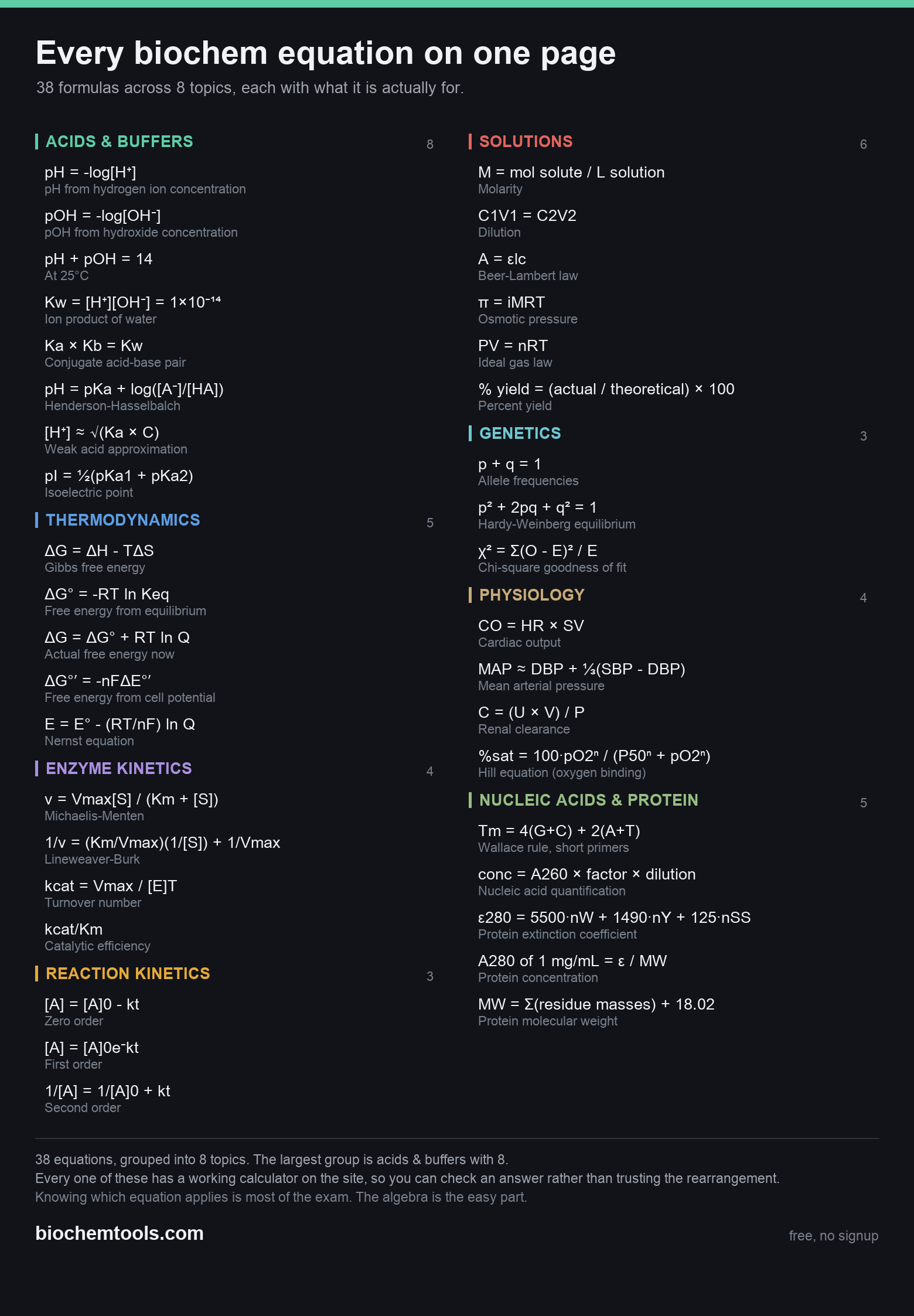
Biochem & MCAT equation sheet
Every formula grouped by topic, with what it actually means and a calculator that solves it. Filter, search, and print.
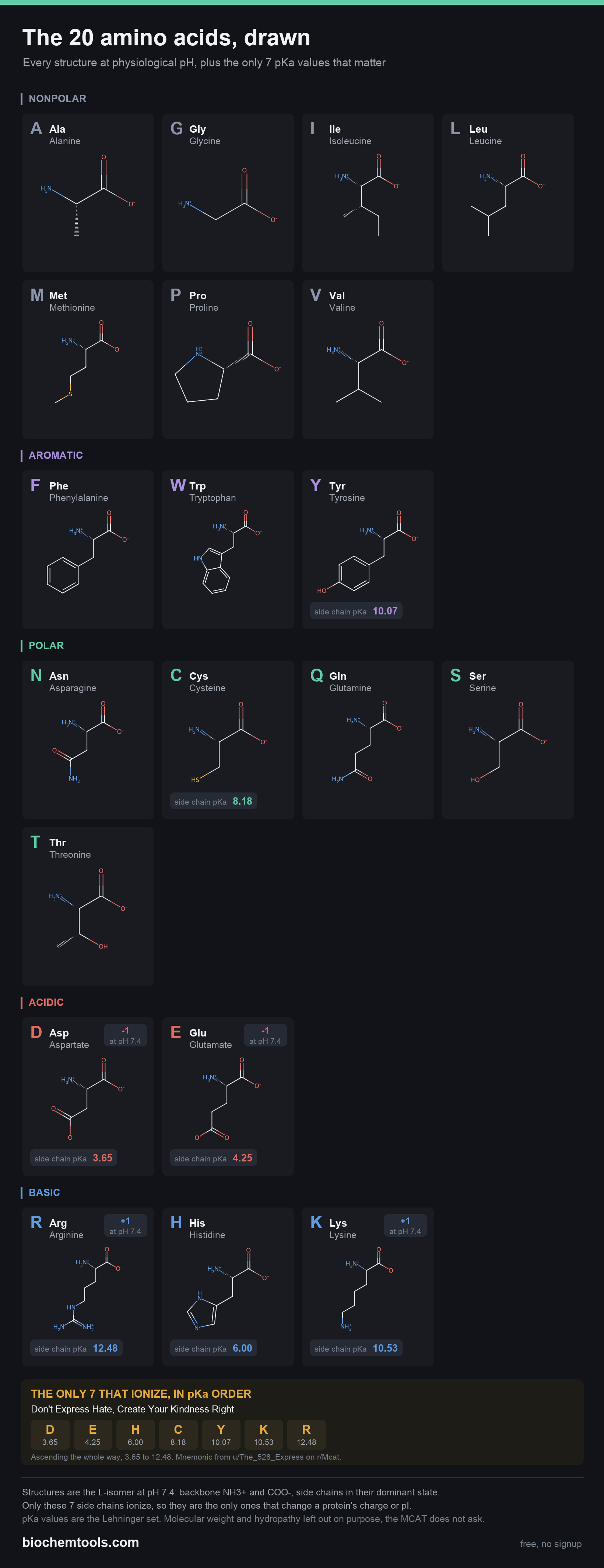
"mcat equation sheet" →Amino acid chart (all 20)
Every amino acid with codes, class, pKa values, pI, molecular weight, hydropathy, and essential status. Filter, search, and sort.
"amino acid chart" →Peptide charge & pI calculator
Net charge at any pH, the isoelectric point, a titration curve, and the full Henderson-Hasselbalch breakdown for every ionizable group.
"how to calculate the pI of a peptide" →Protein MW & extinction coefficient
Paste an amino acid sequence for its molecular weight, 280 nm extinction coefficient, the A280 of 1 mg/mL, theoretical pI, and full composition.
"protein molecular weight from sequence" →Enzyme kinetics simulator
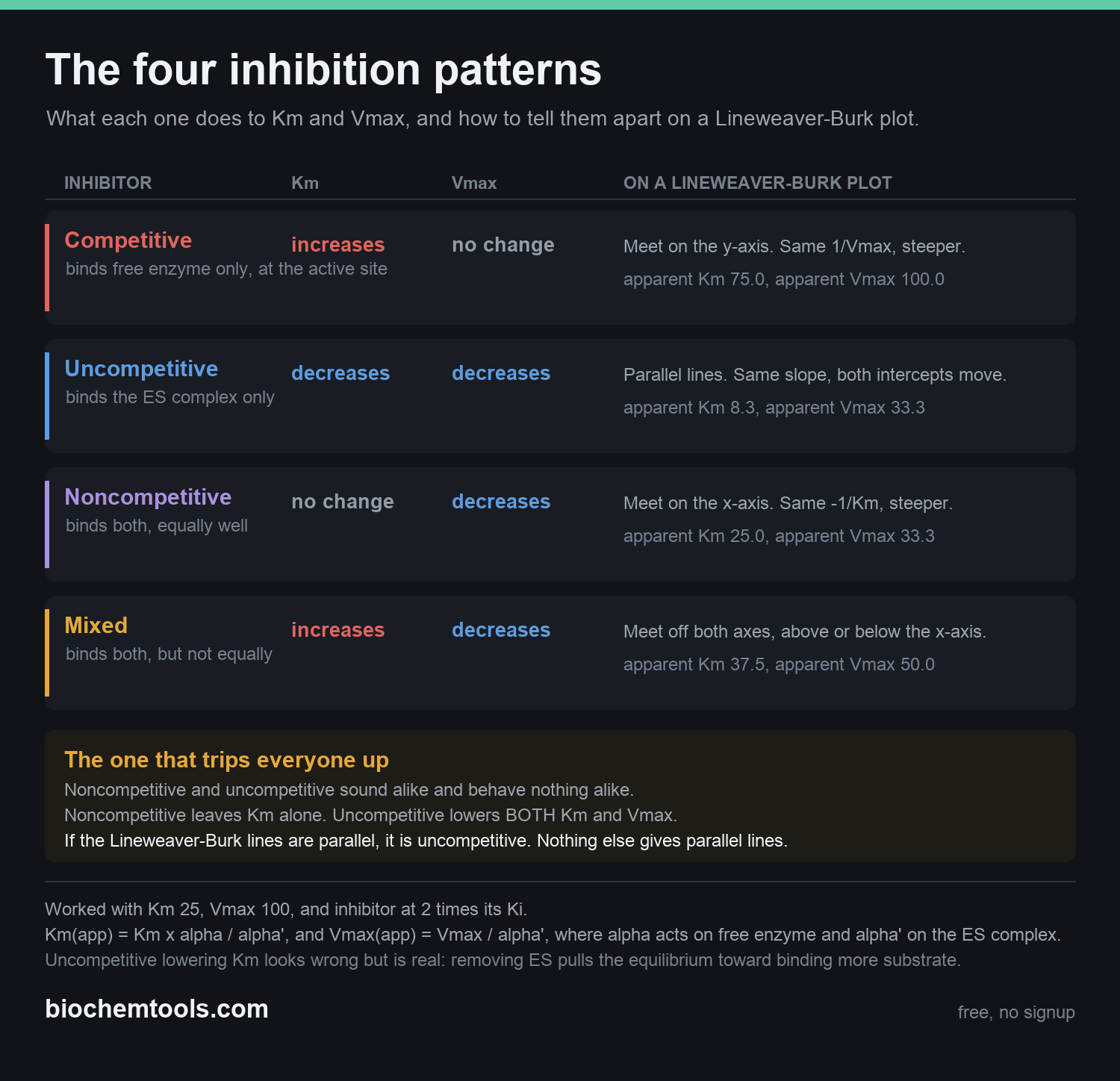
Michaelis-Menten and Lineweaver-Burk plots, live, with competitive / noncompetitive / uncompetitive inhibition and the worked Km and Vmax.
"competitive vs noncompetitive inhibition" →Michaelis-Menten fitter
Paste your enzyme-lab data and instantly get Km, Vmax, and R² with a curve fitted through your points and the regression done for you.
"find Km and Vmax from data" →Amino acid titration curve
Pick an amino acid and see its full titration curve with every buffering region and the pI marked, and worked.
"amino acid titration curve" →Amino acid quiz
Drill all 20 amino acids on one-letter codes, three-letter codes, and class, with instant scoring and a reference table.
"amino acid quiz" →Amino acid catabolism explorer
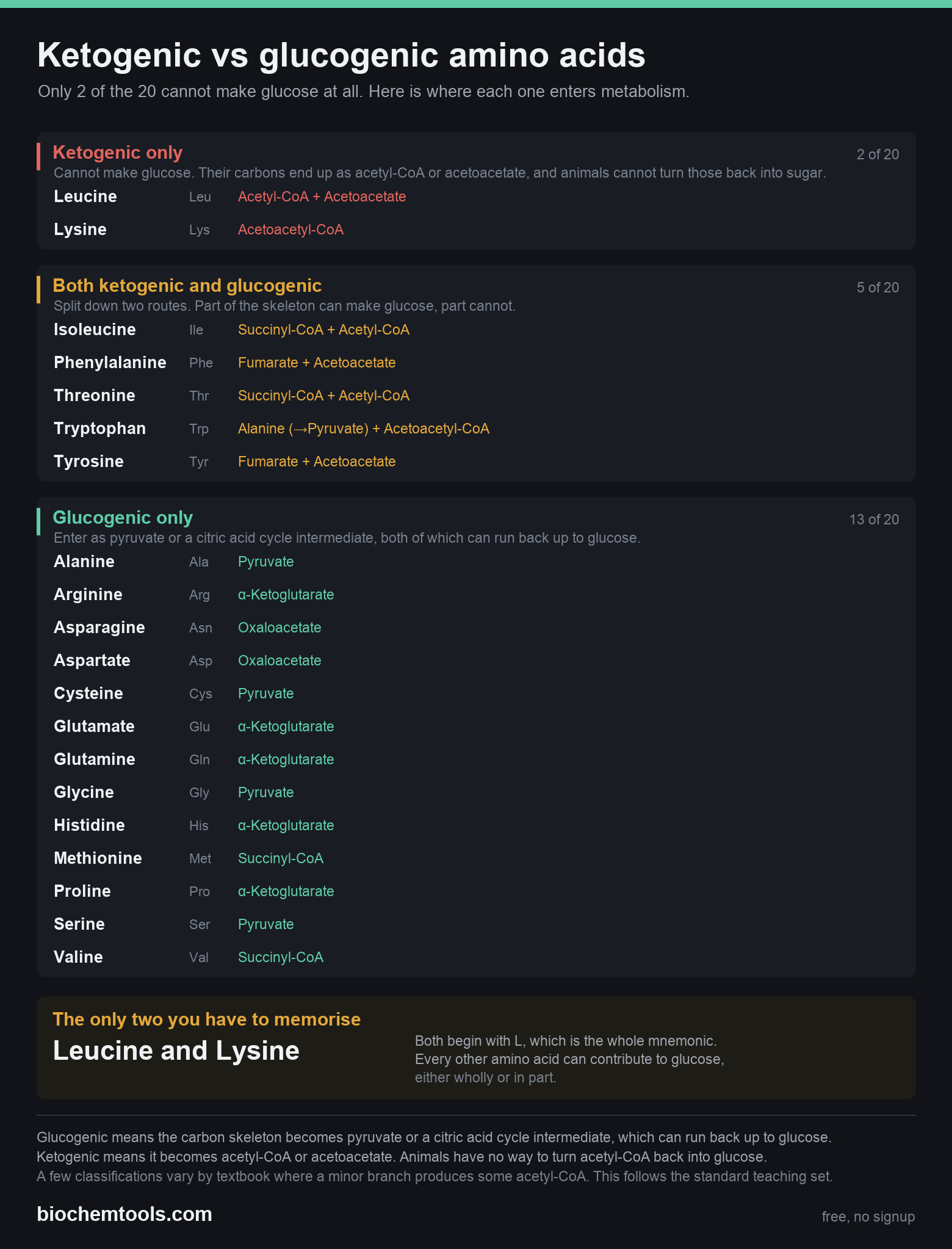
Ketogenic vs. glucogenic for all 20 amino acids, plus the full urea cycle with nitrogen atoms tracked.
"which amino acids are purely ketogenic" →Molecular biology
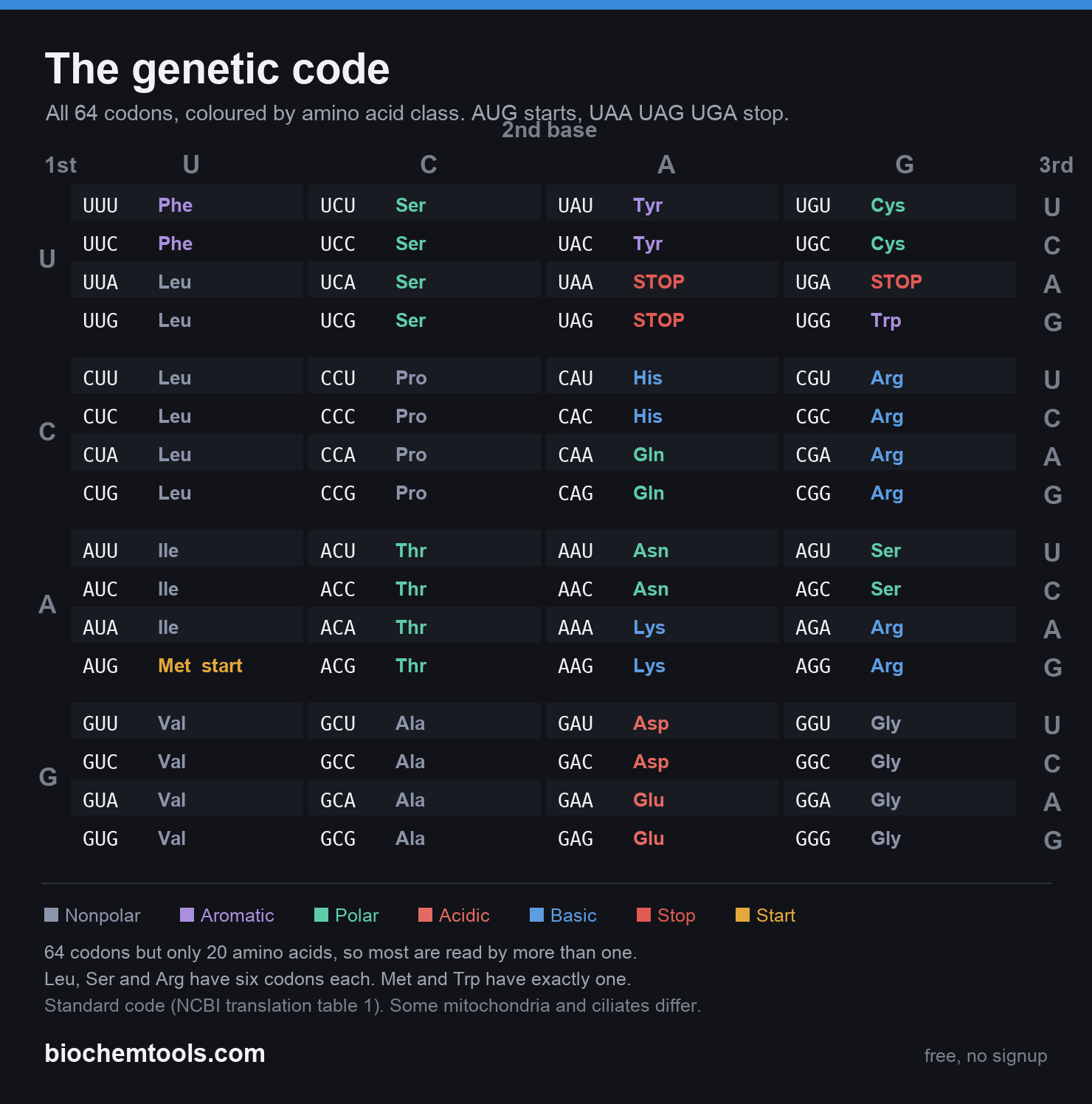
Codon chart (genetic code)
All 64 codons colour-coded by amino acid class, start and stop marked. Switch RNA/DNA and click an amino acid to see every codon for it.
"codon chart" →DNA → protein translation
Transcribe and translate any DNA sequence step by step. See the mRNA, the codons, and the protein with start and stop highlighted, plus the full codon table.
"translate DNA to protein" →DNA melting temp & GC
Paste a primer and get its Tm, GC content, base composition, and reverse complement instantly, with the formula shown.
"primer melting temperature" →DNA & RNA concentration (A260)
Concentration from an A260 reading, plus the 260/280 and 260/230 purity ratios and what they mean.
"a260 a280 ratio dna concentration" →Glycolysis pathway explorer
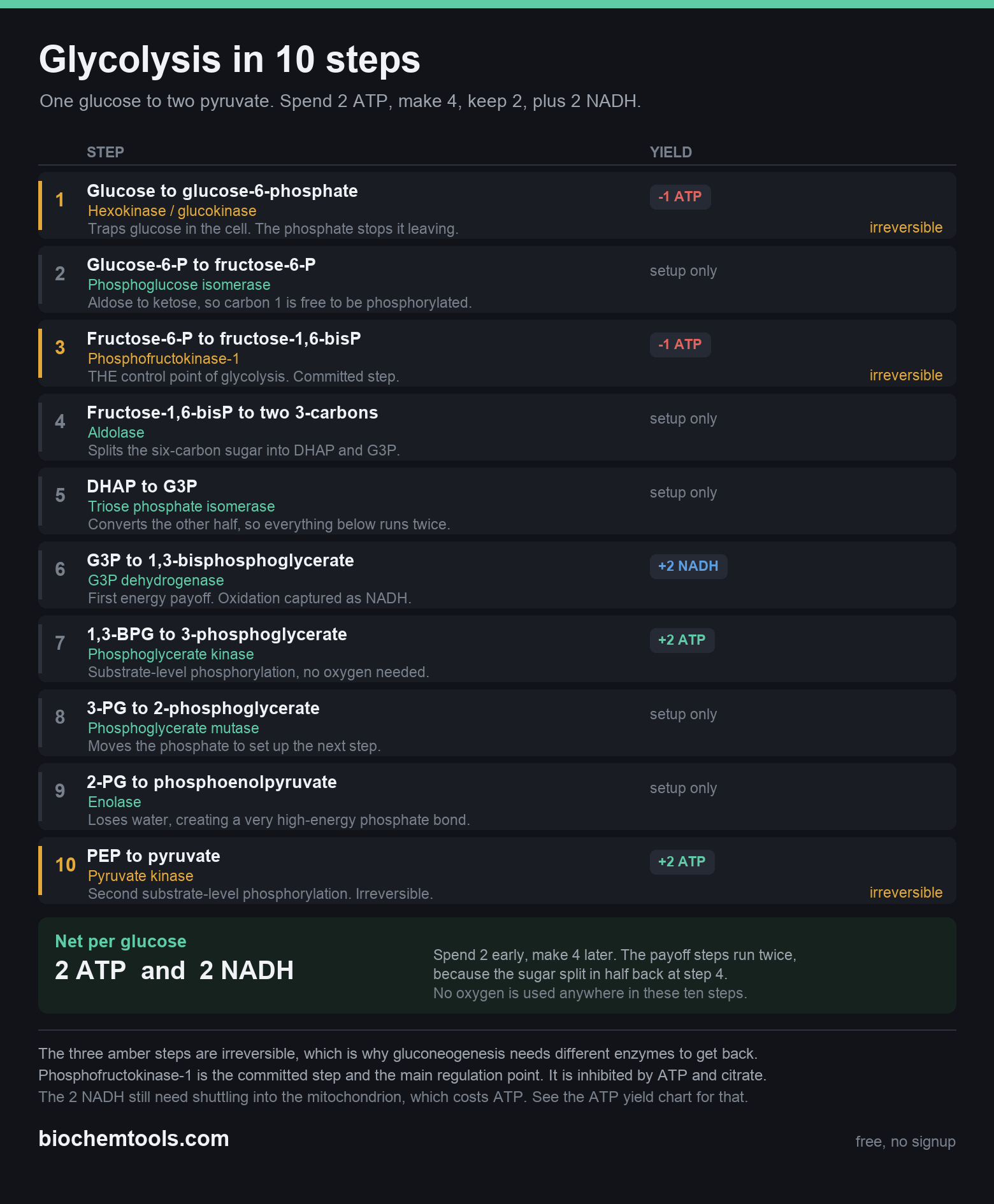
Step through all 10 reactions with a live ATP/NADH tally, every enzyme named, and the three regulated steps highlighted.
"glycolysis steps and net ATP" →How many ATP does glycolysis make?
Net 2 per glucose, 4 made and 2 spent. The exact steps that use ATP and the ones that make it, plus what changes without oxygen.
"glycolysis steps and net ATP" →ATP yield calculator
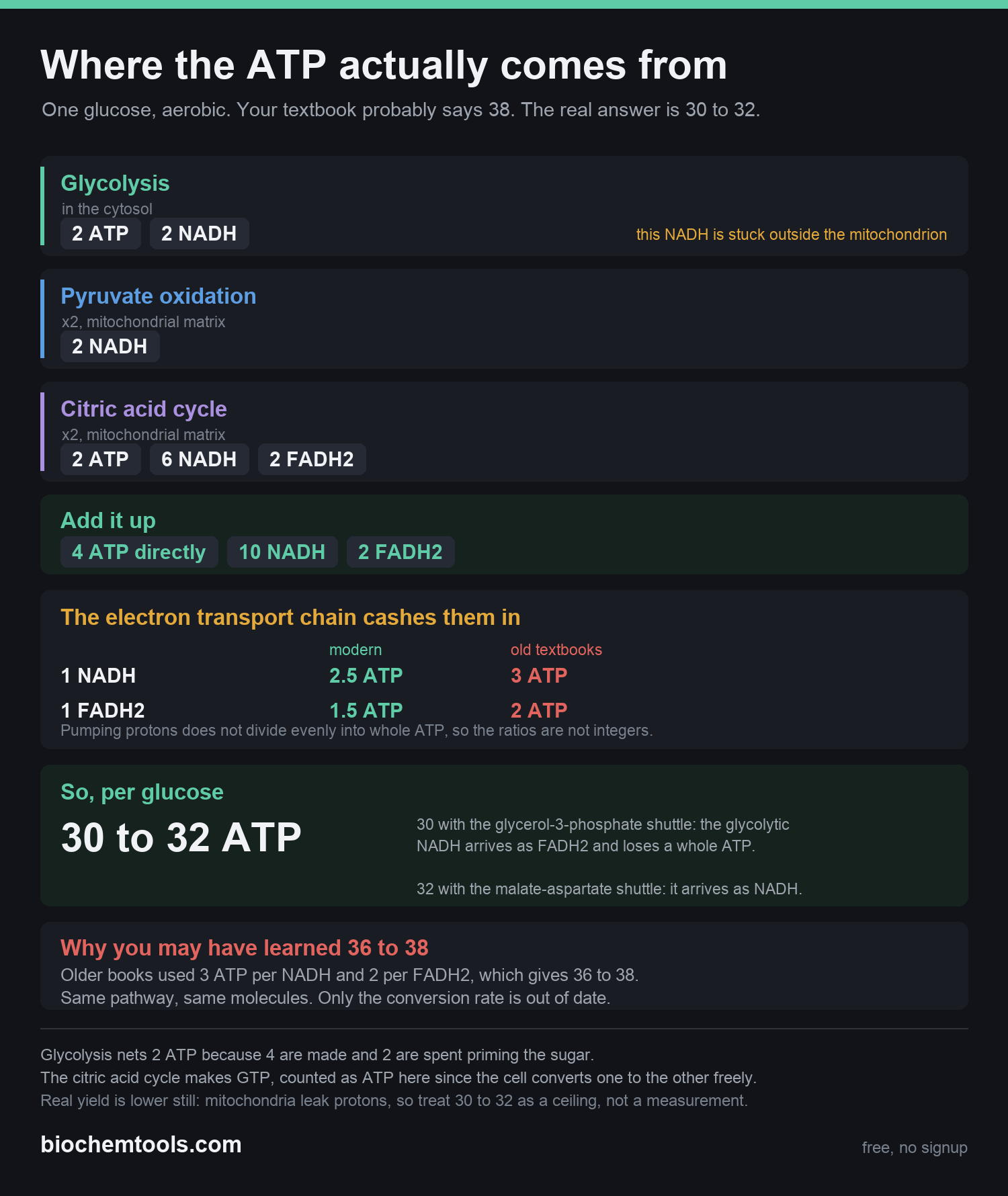
Total ATP per glucose from glycolysis, the TCA cycle, and oxidative phosphorylation. See why textbooks say 30, 32, 36, or 38.
"how many ATP from one glucose" →Citric acid cycle explorer
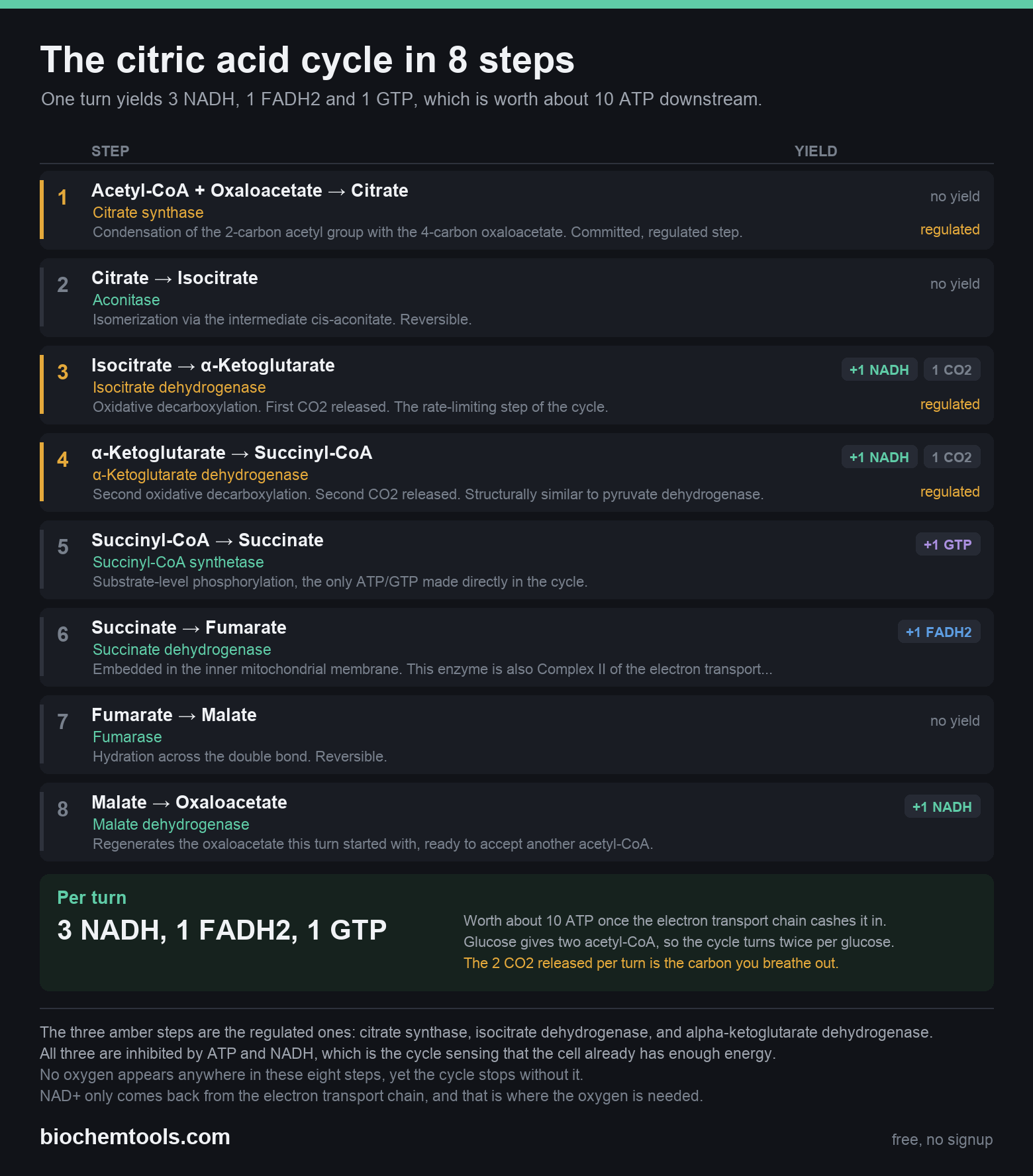
Step through all 8 reactions of the TCA cycle with a live NADH/FADH₂/GTP tally and the three regulated steps highlighted.
"citric acid cycle steps" →Beta-oxidation ATP calculator
Enter any fatty acid's chain length and get total ATP yield from β-oxidation and the TCA cycle, every cycle shown.
"how many ATP from fatty acid oxidation" →Gene expression regulation explorer
Simulate the lac operon under all 4 glucose/lactose conditions, compare it to the trp operon and eukaryotic control.
"lac operon glucose lactose truth table" →Genetics
Punnett square solver
Type two genotypes and get the full square plus genotype and phenotype ratios, monohybrid and dihybrid.
"dihybrid cross calculator" →Punnett square practice problems
A fresh worksheet every click. Blank grids, monohybrid through dihybrid, with a full answer key you can print or leave off.
"punnett square practice worksheet" →Eye color Punnett square
The classic brown/blue square, plus the honest part: eye colour is polygenic, so two blue-eyed parents really can have a brown-eyed child.
"eye color punnett square" →Dihybrid cross calculator
Two genes at once. The full 16-box square with gametes, genotype and phenotype ratios, and why it comes out 9:3:3:1.
"dihybrid cross punnett square" →Blood type Punnett square
Two parent blood types in, every possible child type and the odds out. Handles ABO codominance, unknown genotypes and Rh factor.
"blood type punnett square" →Blood type inheritance
Pick two parents' ABO and Rh genotypes to see every possible child blood type, its probability, and the Punnett square. Codominance shown.
"blood type calculator" →X-linked inheritance
Cross a mother and father for a sex-linked trait like colorblindness to see affected, carrier, and unaffected sons and daughters, with the Punnett square.
"x linked inheritance calculator" →Chi-square genetic ratio
Test whether observed cross counts fit an expected ratio like 3:1 or 9:3:3:1, with the chi-square value, degrees of freedom, a real p-value, and a verdict.
"chi square calculator genetics" →Hardy-Weinberg calculator
Allele and genotype frequencies from p or from counts, plus a chi-square equilibrium test, fully worked.
"hardy weinberg calculator" →How to calculate allele frequency
Count alleles, not individuals. Worked from genotype counts, with the equilibrium check and why the square root shortcut misleads.
"how to calculate allele frequency" →Chemistry
pH calculator
pH, pOH, [H⁺], and [OH⁻] for strong and weak acids and bases, solved exactly, with every step shown.
"pH of a weak acid" →Buffer calculator
Exact acid and conjugate-base amounts to hit any target pH, with the full worked math and a buffering-range check.
"how to make a buffer at a given pH" →Acid-base titration curve
Plot pH vs titrant volume for any strong or weak acid or base, with the equivalence point, half-equivalence (pKa), and buffer region marked.
"titration curve calculator" →Gibbs free energy
Is the reaction spontaneous? Compute ΔG from ΔH/ΔS/T or from ΔG°′ and Q, with the crossover temperature.
"is the reaction spontaneous" →Nernst equation
Cell potential from E°, n, and Q at any temperature, with both the RT/nF and 0.0592/n forms shown.
"nernst equation calculator" →Beer-Lambert calculator
Absorbance ↔ concentration with A = εbc, plus an absorbance/%transmittance converter, fully worked.
"absorbance to concentration" →Ideal gas law (PV = nRT)
Solve for pressure, volume, moles, or temperature with the right gas constant and every step shown.
"ideal gas law calculator" →Chemical equilibrium (Keq)
Solve an ICE table for Keq, compare Q vs K to predict shift direction, and convert Keq straight to ΔG°.
"ice table solver keq" →Reaction half-life & rate law
Zero, first, and second order kinetics: the half-life, concentration at any time from the integrated rate law, and a live decay plot.
"first order half life calculator" →Percent yield calculator
Theoretical yield from the limiting reactant and mole ratio, then percent yield from your actual yield, every step shown.
"how to calculate percent yield" →Percent composition
Enter any chemical formula for the mass percent of every element, the molar mass, and each element's contribution, fully worked.
"percent composition calculator" →Limiting reagent calculator
Enter two reactants and coefficients to find which runs out first and how much excess is left over, every step shown.
"how to find the limiting reactant" →Empirical formula calculator
Turn percent composition or masses into the empirical formula, then the molecular formula from molar mass.
"how to find empirical formula" →Solutions & lab prep
Antibody dilution calculator
Exactly how much antibody and diluent for any 1:X dilution or working concentration, with a warning when the volume is too small to pipette.
"antibody dilution calculator" →Buffer pKa table
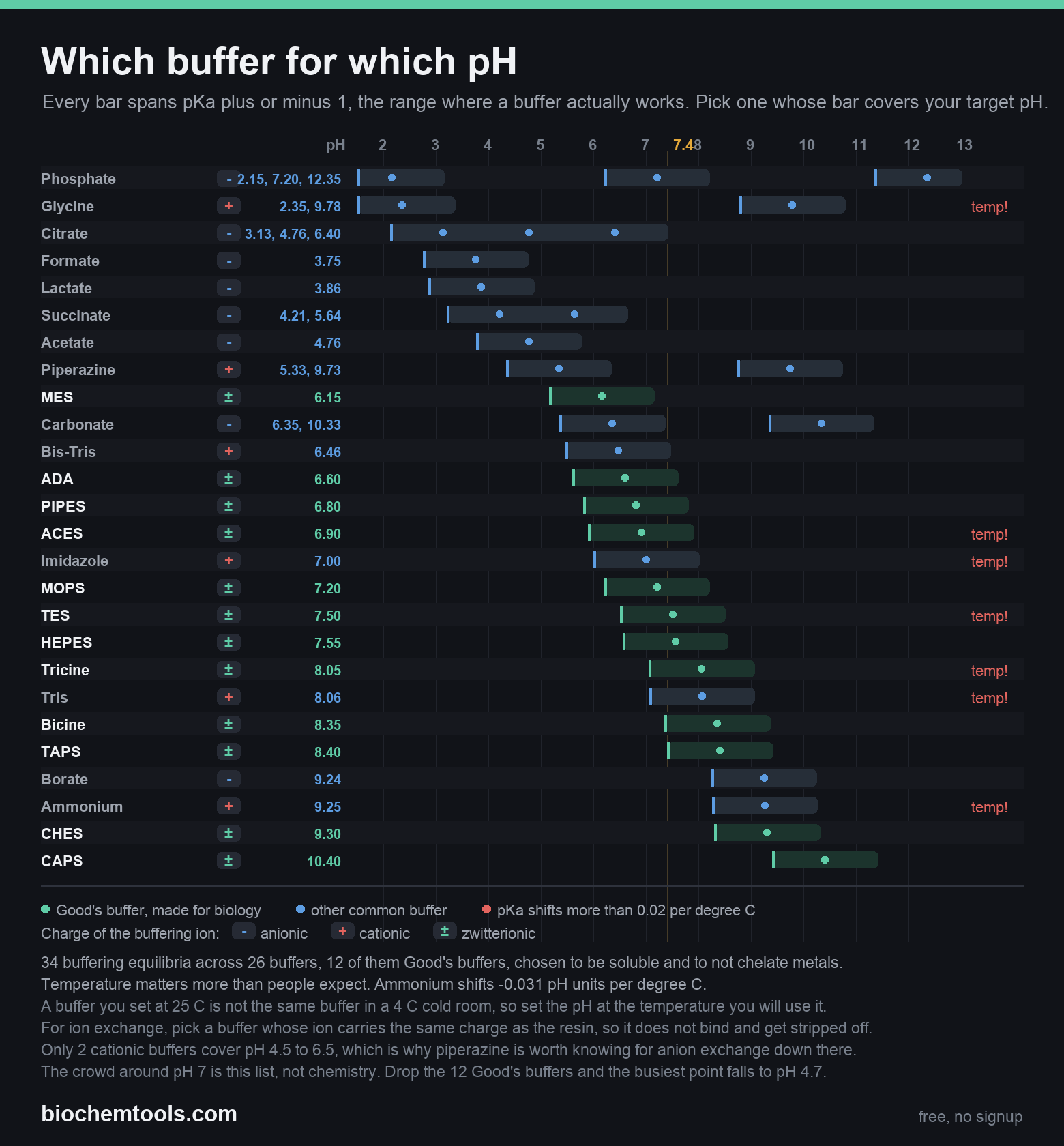
32 buffers with pKa, useful range, and temperature drift. Enter the pH you need and it ranks the buffers that actually work.
"buffer pka table" →Molar mass & molarity
Type any chemical formula for its molar mass, then get the exact grams to weigh for your target concentration and volume.
"how many grams for a solution" →Dilution calculator (C₁V₁ = C₂V₂)
Solve for any variable and see exactly how much stock and solvent to mix, with every step shown.
"dilution calculator" →Serial dilution calculator
The concentration at every step of your series, plus exactly how much sample and diluent to add per tube.
"serial dilution calculator" →Physiology
Osmotic pressure & tonicity
Osmolarity and osmotic pressure from π = iMRT, plus whether it's hypertonic, isotonic, or hypotonic to blood.
"osmotic pressure calculator" →Cardiac output calculator
Solve CO two ways, HR × SV, or Fick's principle from oxygen consumption and the A-V O₂ difference, with every step shown.
"cardiac output calculator" →Renal clearance calculator
Find GFR or renal plasma flow from urine and plasma concentrations, plus filtration fraction, fully worked.
"renal clearance calculator" →Membrane transport explorer
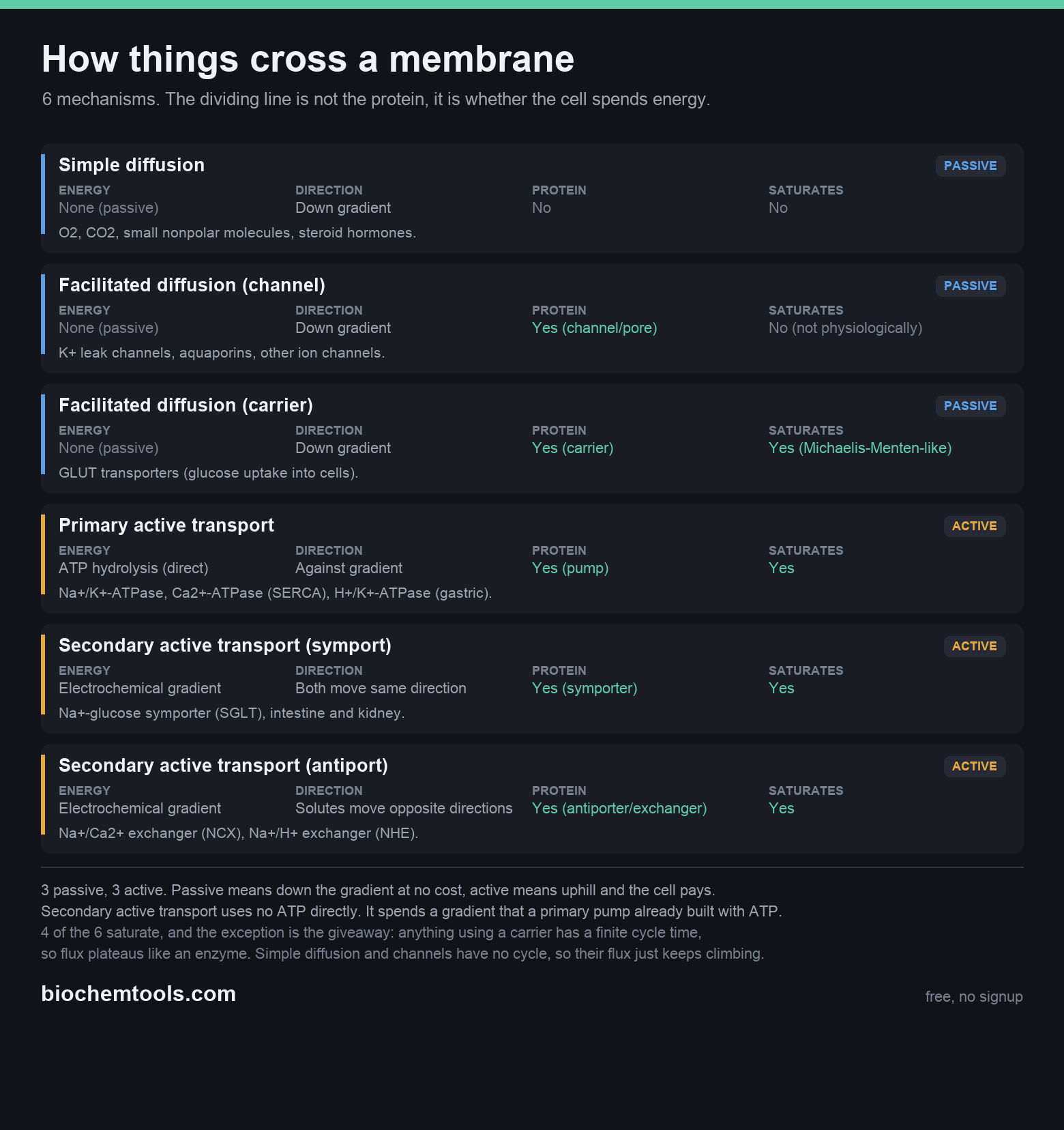
Simple diffusion vs. facilitated vs. active transport compared side by side, plus the Na⁺/K⁺-ATPase in detail.
"facilitated diffusion vs active transport" →Oxygen-hemoglobin dissociation curve
Myoglobin vs. adult vs. fetal hemoglobin curves, exact %saturation at any pO₂, and why the Bohr effect shifts the curve.
"bohr effect explained" →No tools match that search. Clear search
Why these are different
A calculator gives you a number. A cheat sheet gives you facts to memorize. Neither teaches you the method, which is what you need when there's no calculator on the exam.
Shows the work
Every tool walks through the actual method step by step as you change the inputs, not just a final number.
Free, no signup
No account, no paywall, no email capture. Open a tool and use it, that's the whole flow.
Built for MCAT
Every formula, worked example, and practice problem is scoped to what pre-med and MCAT courses actually test.