| Stage | NADH | FADH₂ | Substrate-level |
|---|---|---|---|
| Glycolysis | 2 (cytosolic) | , | 2 ATP |
| Pyruvate dehydrogenase (×2) | 2 | , | , |
| Citric acid cycle (×2 turns) | 6 | 2 | 2 GTP |
| Total | 10 | 2 | 4 |
How the total is actually built
Every glucose makes 4 ATP directly (substrate-level phosphorylation: 2 from glycolysis, 2 from the TCA cycle's GTP) with no oxygen required. Everything else comes from oxidative phosphorylation: the 10 NADH and 2 FADH₂ produced along the way feed electrons into the electron transport chain, and the proton gradient that creates drives ATP synthase. How much ATP each NADH or FADH₂ is "worth", the P/O ratio, is where the textbook disagreement comes from.
2 of those 10 NADH are made in the cytosol during glycolysis, but NADH itself can't cross the inner mitochondrial membrane. A shuttle system moves the electrons across instead, and depending on which shuttle a tissue uses, those 2 NADH end up worth either a full NADH's worth of ATP (malate-aspartate shuttle) or only a FADH₂'s worth (glycerol-3-phosphate shuttle), which is the second source of disagreement.
Related tools: Glycolysis pathway explorer · Beta-oxidation ATP calculator · all biochem tools.
Worked example: modern accounting, malate-aspartate shuttle (the default)
Switch the shuttle to glycerol-3-phosphate and those 2 cytosolic NADH drop to 1.5 ATP each instead of 2.5, total falls to 30 ATP. Switch to classic P/O ratios (3.0/2.0) and the same two shuttle choices give 38 or 36 ATP instead. All four are "correct". They're just different, equally real conventions.
Practice problems
1. Using classic P/O ratios (NADH = 3, FADH₂ = 2) and the glycerol-3-phosphate shuttle, what's the total ATP yield?
Show answer
2. A muscle cell uses the glycerol-3-phosphate shuttle and modern P/O ratios. If glycolysis were somehow blocked entirely (no glucose breakdown past that point), how much of the 30 ATP total would be lost, and why is it more than just the 2 substrate-level ATP from glycolysis itself?
Show answer
Printable ATP yield chart
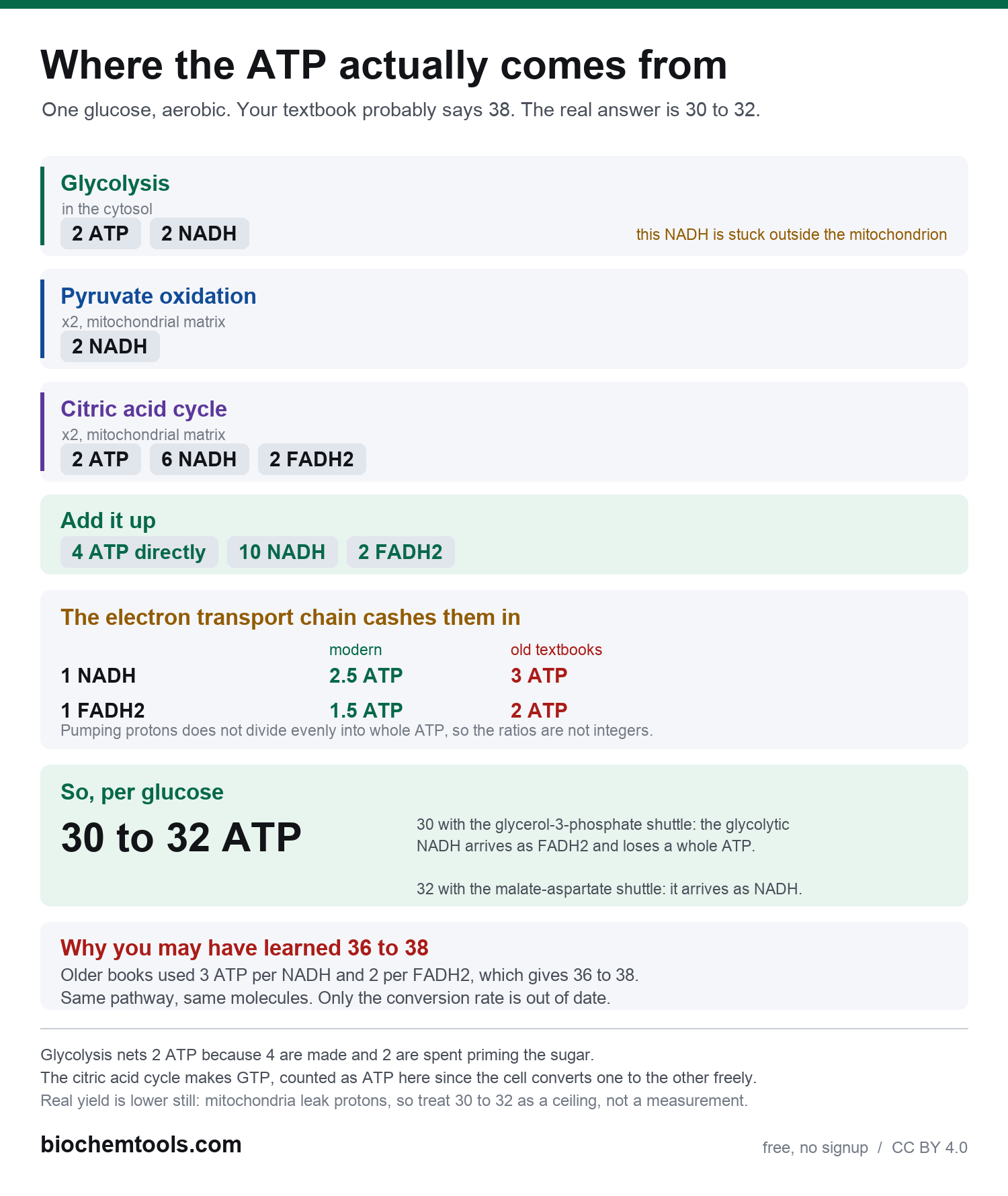
The whole accounting on one page: what each stage produces, what the electron transport chain converts it into, and why the answer is a range rather than a single number.
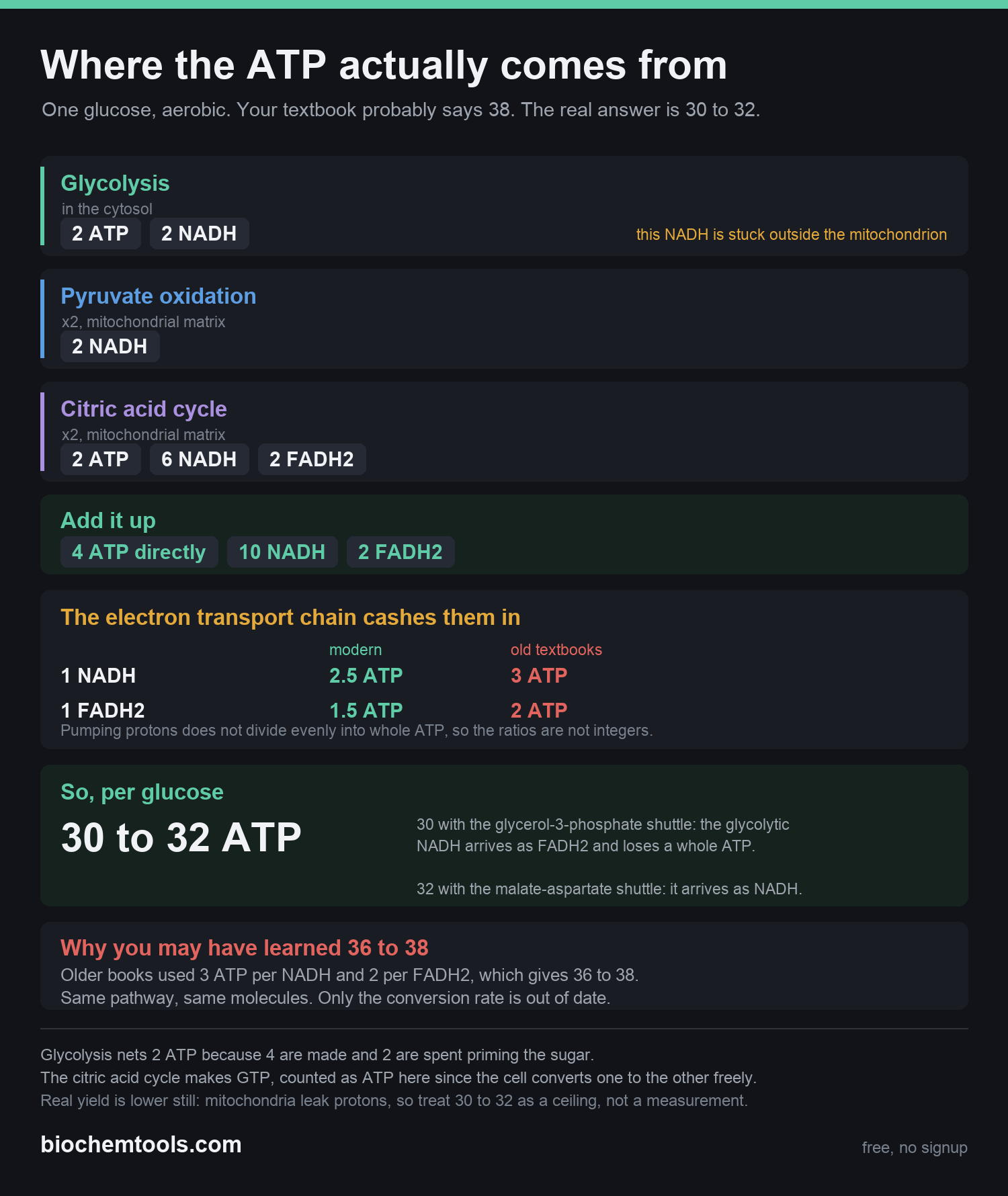
Download the chart, or the print-friendly white version. Free for a study guide or class handout, no attribution needed. See all the printable charts. Every figure on it is generated from the same arithmetic this calculator uses, so the two cannot disagree.
FAQ
Is the answer 36, 38, 30, or 32 ATP?
All four are defensible depending on convention. 36/38 use the older P/O ratios (3 and 2); 30/32 use modern measured values (2.5 and 1.5). Within each pair, the shuttle for cytosolic NADH picks the lower or higher number. Check which convention your course uses.
Why does cytosolic NADH need a shuttle?
NADH can't cross the inner mitochondrial membrane. A shuttle moves the electrons across instead, regenerating NADH (malate-aspartate) or FADH₂ (glycerol-3-phosphate) on the mitochondrial side, which is exactly why those 2 NADH end up worth a different amount depending on the shuttle.
Why isn't the P/O ratio a whole number?
ATP synthase needs roughly 4 protons per ATP, and the measured protons pumped per NADH or FADH₂ oxidized doesn't divide evenly by 4. The modern 2.5/1.5 values come from that more precise accounting; 3/2 is the older simplified approximation.
Does this whole 30-38 ATP range assume oxygen is available?
Yes, every number on this page is the aerobic total, since it all depends on the electron transport chain being able to run (which needs O₂ as the final electron acceptor). Without oxygen, none of the 10 NADH or 2 FADH₂ can be used at all, the citric acid cycle and oxidative phosphorylation both shut down, and the cell falls back on glycolysis with fermentation to regenerate NAD⁺. Total yield in that case is just glycolysis's own net 2 ATP per glucose, roughly 15-16× less than the aerobic total.
Sources and how to cite this page
This uses the modern P/O ratios of about 2.5 ATP per NADH and 1.5 ATP per FADH₂, the values supported by direct measurement and reviewed in Hinkle, P.C., “P/O ratios of mitochondrial oxidative phosphorylation,” Biochimica et Biophysica Acta 1706(1–2):1–11, 2005. They are not whole numbers because proton pumping and ATP synthase turning are not stoichiometrically locked to each other.
Why some sources still say 3 and 2. Older textbooks use 3 ATP per NADH and 2 per FADH₂, giving 38 ATP per glucose instead of the roughly 30 to 32 you get with the modern values. Both appear in courses and on exams. If your class uses the older numbers, use those and say which convention you are following, because the total is meaningless without it.
Cite this page
Just the glycolysis number? How many ATP are produced in glycolysis? Net 2 ATP per glucose, with the exact steps that spend and make it.