One turn of the cycle, and why it runs twice per glucose
One acetyl-CoA entering the cycle (one "turn") yields 3 NADH, 1 FADH₂, 1 GTP, and 2 CO₂, while regenerating the oxaloacetate the cycle started with so it can accept another acetyl-CoA. Glycolysis produces 2 pyruvate per glucose, and pyruvate dehydrogenase converts each pyruvate into one acetyl-CoA, so the cycle runs twice per original glucose, doubling everything to 6 NADH, 2 FADH₂, 2 GTP, and 4 CO₂. Those are exactly the citric acid cycle numbers used in the ATP yield calculator.
This is specifically the aerobic continuation of glucose breakdown, the cycle only runs when oxygen is available to keep the electron transport chain (and therefore NAD⁺ regeneration) going. Without oxygen, pyruvate never reaches this cycle at all; it goes to fermentation instead, purely to regenerate the NAD⁺ glycolysis needs. See what happens to pyruvate and NADH without oxygen for that side of the fork.
Model note: standard textbook citric acid cycle (Lehninger). GTP is counted as ATP-equivalent (nucleoside diphosphate kinase interconverts them freely), matching the convention used across this site.
Related tools: ATP yield calculator · Glycolysis pathway explorer · Beta-oxidation ATP calculator · all biochem tools.
Worked example: the running tally, step by step
Tracking cumulative NADH, FADH₂, GTP, and CO₂ after each step, exactly what the tally bar above computes as you click through:
Both carbons lost as CO₂ (steps 3 and 4) come from the oxaloacetate/citrate carbon skeleton, not directly from the acetyl-CoA that entered this turn, but the cycle still nets zero carbons gained, since oxaloacetate is fully regenerated by step 8.
Printable citric acid cycle chart
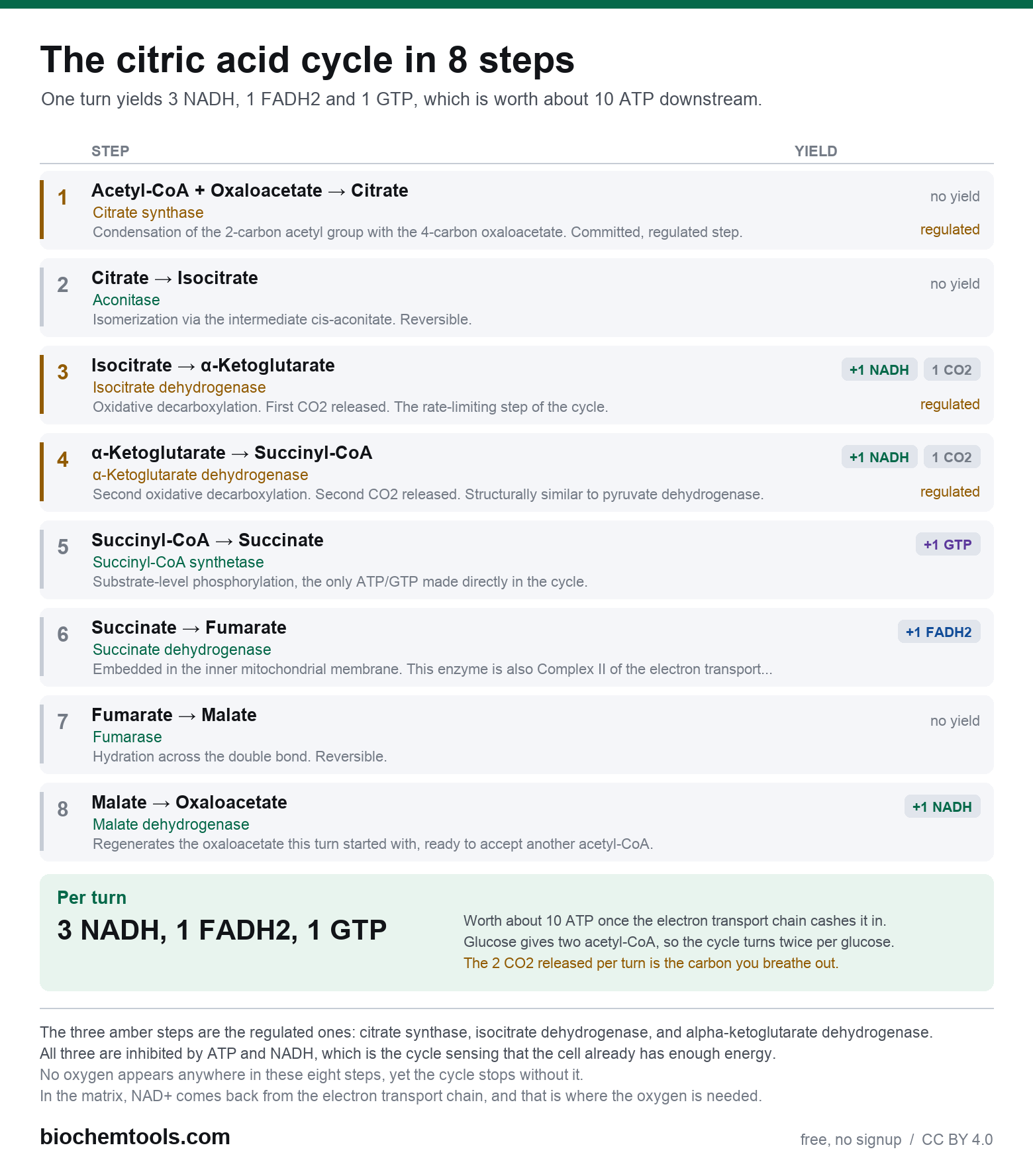
All eight steps on one page with the enzyme for each, what it yields, and which three are regulated. Pairs with the glycolysis chart, since together they cover almost everything before the electron transport chain.
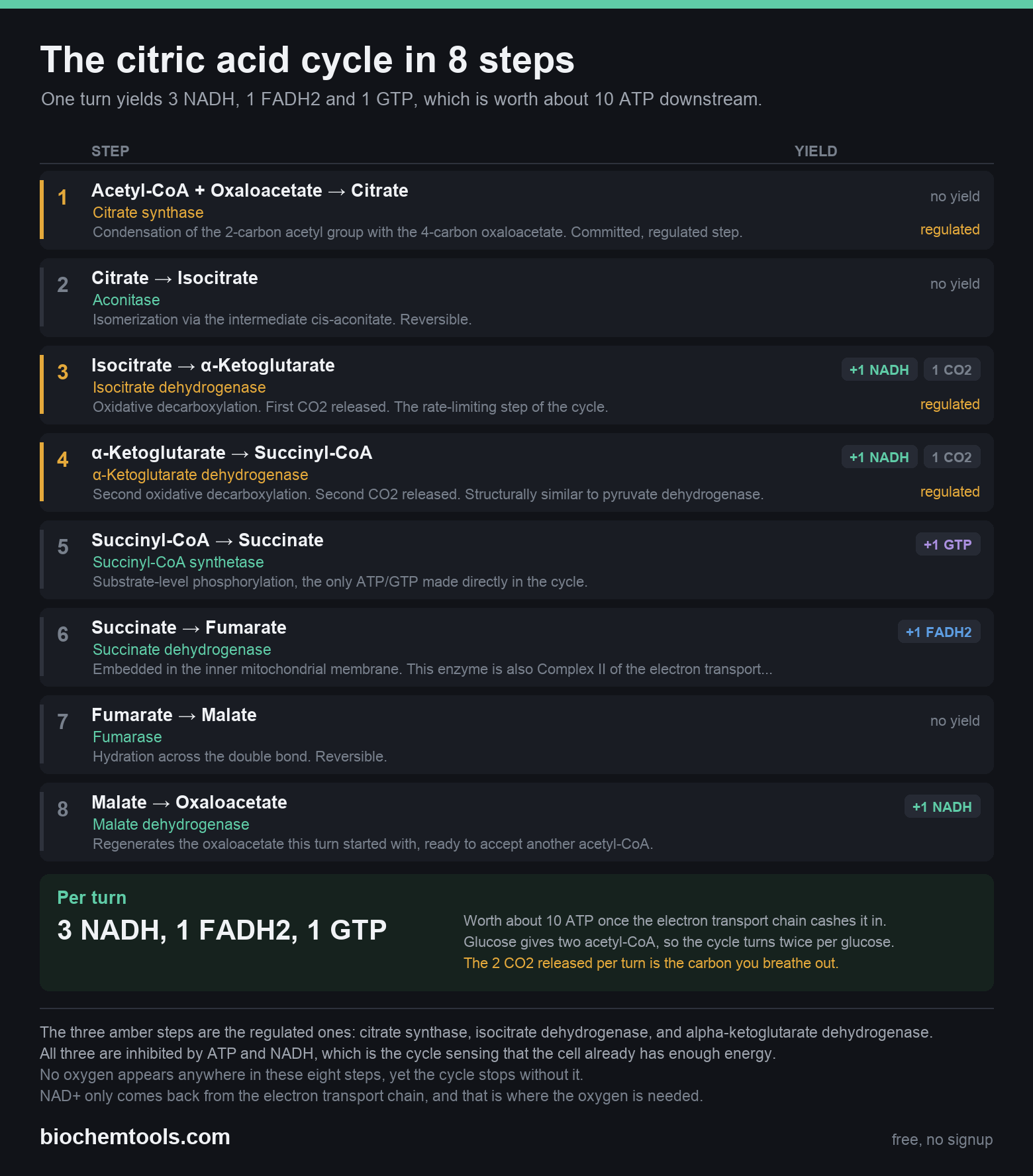
Download the chart, or the print-friendly white version. Free for a study guide or class handout, no attribution needed. See all the printable charts.
FAQ
What is the yield of one turn of the cycle?
Per acetyl-CoA: 3 NADH, 1 FADH₂, 1 GTP, 2 CO₂. Twice per glucose (2 acetyl-CoA from 2 pyruvate): 6 NADH, 2 FADH₂, 2 GTP, 4 CO₂.
What are the three regulated steps?
Citrate synthase (step 1), isocitrate dehydrogenase (step 3, rate-limiting), and α-ketoglutarate dehydrogenase (step 4), all irreversible under cellular conditions, inhibited by high ATP/NADH, activated by ADP/calcium.
Why is succinate dehydrogenase different from the rest?
It's the only cycle enzyme embedded in the inner mitochondrial membrane, since it doubles as Complex II of the electron transport chain. Its FADH₂ electrons feed the ETC directly, unlike the NADH from the other three oxidative steps.
Is the GTP the same as ATP?
Functionally yes for energy accounting, nucleoside diphosphate kinase readily interconverts GTP and ATP, so most textbooks (and this site's ATP yield calculator) count them as equivalent.
Practice problems
1. A cell processes 10 acetyl-CoA through the citric acid cycle (10 turns). What's the total NADH, FADH₂, GTP, and CO₂?
Show answer
2. Using the modern P/O ratios from the ATP yield calculator (2.5 ATP/NADH, 1.5 ATP/FADH2), how much total ATP does one full turn of the citric acid cycle contribute, counting both oxidative phosphorylation and the substrate-level GTP?
Show answer
Just the glycolysis number? How many ATP are produced in glycolysis? Net 2 ATP per glucose, with the exact steps that spend and make it.