Net 2 ATP
Four ATP are made and two are spent, so one glucose nets 2 ATP. Glycolysis also produces 2 NADH and 2 pyruvate.
This is true with or without oxygen. Glycolysis itself never uses oxygen.
Where each ATP goes
Only four of the ten steps of glycolysis touch ATP at all. Two spend it, two make it, and the two that make it each run twice because glucose has been split in half by then.
| Step | Enzyme | Reaction | ATP |
|---|---|---|---|
| 1 | Hexokinase | Glucose to glucose-6-phosphate | -1 ATP |
| 3 | Phosphofructokinase-1 | Fructose-6-P to fructose-1,6-bisP | -1 ATP |
| 7 | Phosphoglycerate kinase | 1,3-BPG to 3-phosphoglycerate | +2 ATP |
| 10 | Pyruvate kinase | PEP to pyruvate | +2 ATP |
| Net per glucose | +2 ATP | ||
Steps 7 and 10 show +2 rather than +1 because aldolase splits the six-carbon sugar into two three-carbon molecules at step 4. Everything after that happens twice per glucose.
Why the net is 2 and not 4
Glycolysis spends before it earns. Hexokinase uses one ATP at step 1 to attach a phosphate to glucose, which traps it inside the cell because the charged molecule cannot cross the membrane back out. Phosphofructokinase-1 spends a second ATP at step 3, the committed step of the whole pathway.
Those two are an investment. The payoff phase then generates four ATP, so the cell finishes two ahead. If a question asks how many ATP glycolysis produces, four is defensible. If it asks for the net, or what the cell actually gains, the answer is two, and that is what most courses want.
How that ATP is actually made
By substrate-level phosphorylation, which means a phosphate is handed directly from a high-energy intermediate onto ADP. Phosphoglycerate kinase does it at step 7 and pyruvate kinase at step 10.
No electron transport chain, no proton gradient, no oxygen. That is the whole reason glycolysis still runs in a sprinting muscle or a fermenting yeast cell, and why it is the one pathway essentially every organism on Earth shares.
With oxygen versus without
Glycolysis nets the same 2 ATP either way. What changes is everything downstream.
Without oxygen, the cell still has to deal with the 2 NADH it just made. NAD+ has to come back or glycolysis stalls at step 6, so pyruvate gets converted to lactate (in muscle) or ethanol (in yeast) purely to regenerate it. Those 2 ATP are the entire yield.
With oxygen, the 2 pyruvate enter the mitochondrion and the 2 NADH get cashed in by the electron transport chain, bringing the total for one glucose to roughly 30 to 32 ATP. Glycolysis is about 6 percent of that.
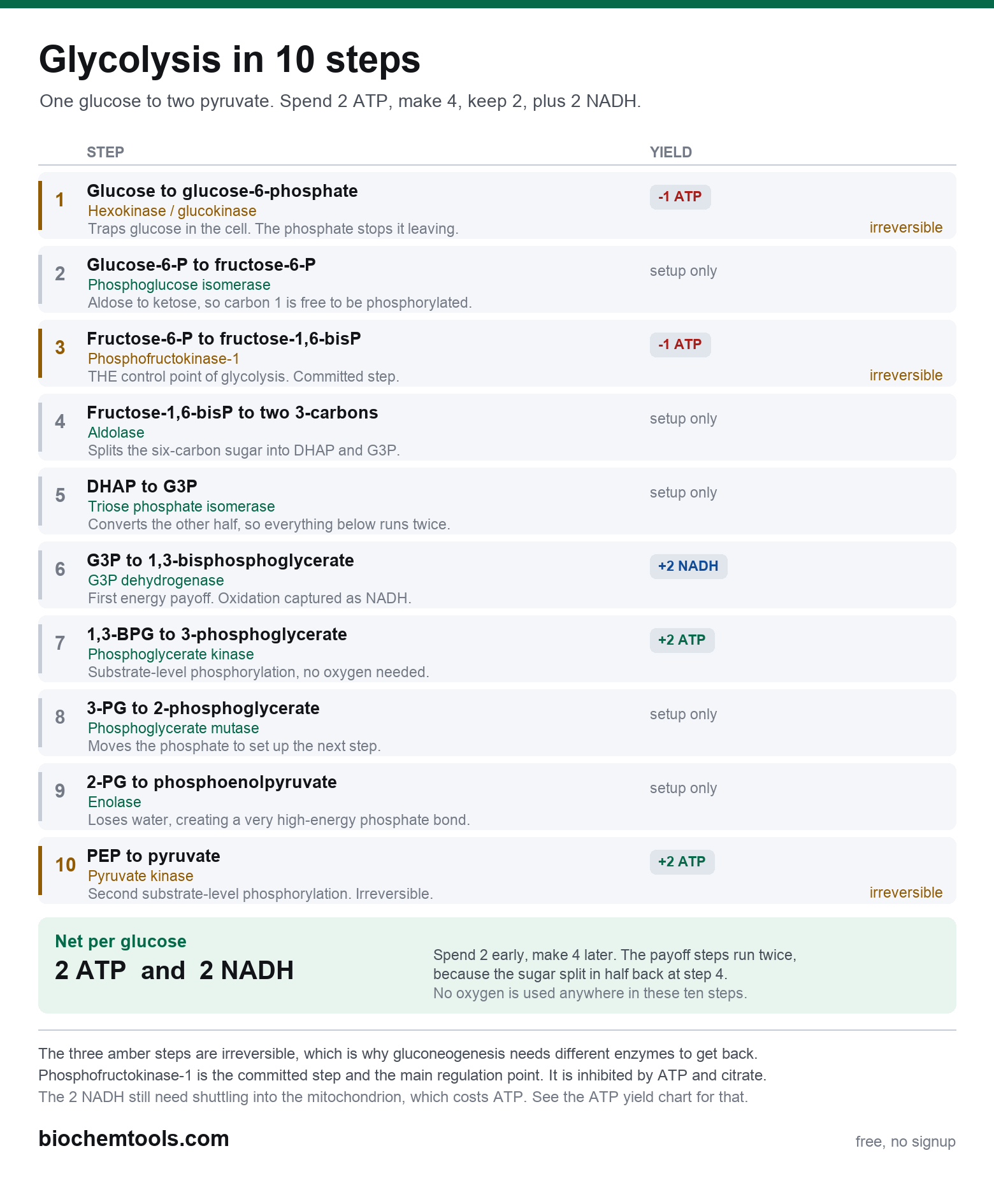
The whole pathway on one page
Every step with its enzyme, what it costs and what it yields, and the three regulated steps marked.
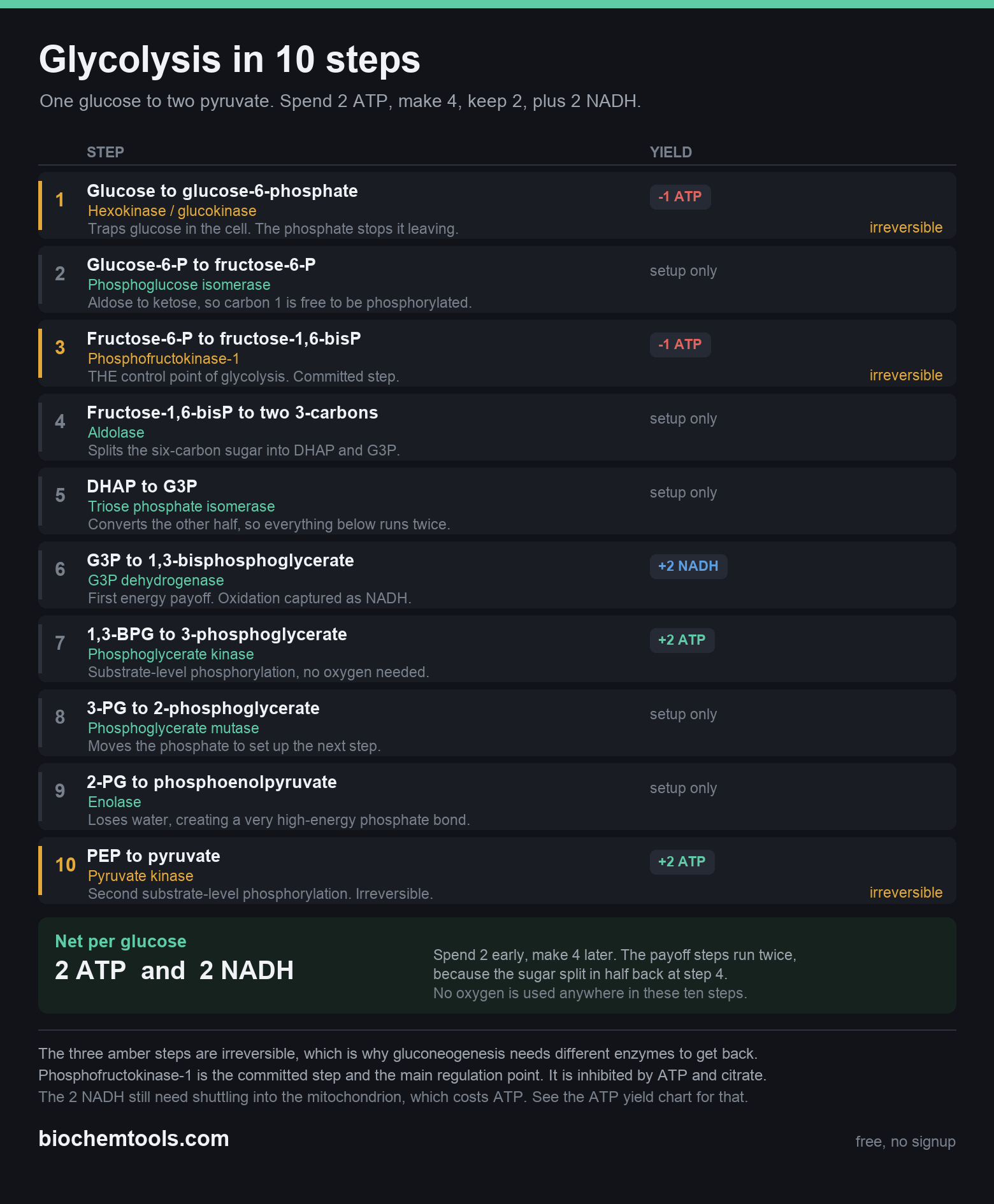
Download the chart, or the print-friendly white version. Free for a handout, no attribution needed.
Work through it yourself
If the net yield still feels like arithmetic rather than something you understand, stepping through the pathway one reaction at a time with a running tally usually fixes it.
Glycolysis pathway explorer, one step at a time with a live ATP and NADH count.
ATP yield calculator, for the full 30 to 32 per glucose including the citric acid cycle.
Citric acid cycle explorer, where the pyruvate goes next.
Common questions
How many ATP are produced in glycolysis?
Glycolysis nets 2 ATP per molecule of glucose. Four ATP are made during the payoff phase, but two were already spent priming the sugar in the investment phase, so the net gain is 2 ATP. Glycolysis also produces 2 NADH and 2 pyruvate.
Why does glycolysis have a net gain of only 2 ATP?
Because glycolysis spends ATP before it makes any. Hexokinase uses 1 ATP at step 1 and phosphofructokinase-1 uses another at step 3, both to phosphorylate the sugar and trap it inside the cell. The payoff phase then produces 4 ATP, 2 from each of the two three-carbon halves. Four made minus two spent leaves a net of 2.
How many ATP molecules are produced during glycolysis in total?
Four ATP are produced in total, by phosphoglycerate kinase and pyruvate kinase, each running twice because one glucose is split into two three-carbon sugars. The gross figure is 4 and the net figure is 2. Exam questions usually want the net.
Does glycolysis produce ATP without oxygen?
Yes. Glycolysis itself needs no oxygen and nets the same 2 ATP whether oxygen is present or not. What changes without oxygen is what happens next: the cell must regenerate NAD+ by fermentation, converting pyruvate to lactate or ethanol, so those 2 ATP are all it gets.
How is ATP made in glycolysis?
By substrate-level phosphorylation, meaning a phosphate group is transferred directly from a high-energy intermediate onto ADP. Phosphoglycerate kinase does this at step 7 and pyruvate kinase at step 10. No electron transport chain or oxygen is involved, which is why glycolysis works anaerobically.
What is the net ATP production of glycolysis per glucose?
Net 2 ATP, 2 NADH and 2 pyruvate per glucose. If oxygen is available those 2 NADH and the 2 pyruvate go on to yield far more ATP downstream, bringing the total for complete glucose oxidation to roughly 30 to 32 ATP.
How many ATP does glycolysis use?
Two. One at step 1 (hexokinase, glucose to glucose-6-phosphate) and one at step 3 (phosphofructokinase-1, fructose-6-phosphate to fructose-1,6-bisphosphate). Both are irreversible and both are regulated.
Is the answer 2 ATP or 4 ATP?
Both are correct depending on what is asked. Gross production is 4 ATP. Net gain is 2 ATP. If a question says "net" or asks what the cell gains, the answer is 2. If it asks how many are produced or synthesized, 4 is defensible, though most courses still expect 2.
Sources
Step order, enzymes and stoichiometry follow the standard treatment in Nelson, D.L. & Cox, M.M., Lehninger Principles of Biochemistry, chapter 14. The net yield of 2 ATP, 2 NADH and 2 pyruvate per glucose is universal across textbooks. Where courses differ is in the downstream ATP-per-NADH ratio, which affects the 30 to 32 total but never the glycolysis figure itself.