Glycolysis: net yield and the three regulated steps
Per molecule of glucose, glycolysis invests 2 ATP in the early "investment phase" (hexokinase and PFK-1), then the "payoff phase" runs twice, once for each three-carbon sugar, producing 4 ATP and 2 NADH. Net: 2 ATP, 2 NADH, and 2 pyruvate. The three irreversible, regulated steps are hexokinase (step 1), phosphofructokinase-1 (step 3, the committed step and main control point), and pyruvate kinase (step 10).
Model note: standard textbook glycolysis (Lehninger). NADH yield is shown per glucose (the GAPDH step runs twice). Some courses track GTP vs. ATP separately in later metabolism. Here all substrate-level phosphorylations are counted as ATP.
Just need the number? How many ATP are produced in glycolysis answers it directly: net 2 per glucose, 4 made and 2 spent.
Related tools: Enzyme kinetics simulator · Gibbs free energy calculator · Beta-oxidation ATP calculator · all biochem tools.
Worked example: the running tally, step by step
Tracking cumulative ATP and NADH after each step. This is exactly what the tally bar above computes as you click through:
The investment phase (steps 1-3) spends 2 ATP up front, bringing the running total to −2. Everything from step 6 onward happens twice (once for each 3-carbon half of the original glucose), which is why the payoff phase adds 4 ATP total (2 per pass × 2 passes), enough to repay the 2 invested and net +2 overall.
What happens to pyruvate and NADH next?
Glycolysis on its own doesn't finish oxidizing glucose. It hands off two things that both need somewhere to go: 2 pyruvate and 2 NADH. Which path they take depends entirely on whether oxygen is available.
With oxygen (aerobic): pyruvate dehydrogenase converts each pyruvate into acetyl-CoA, which feeds the citric acid cycle. The 2 NADH from glycolysis get shuttled into the mitochondria and, along with everything the citric acid cycle produces, feed the electron transport chain. See the ATP yield calculator for the full accounting, typically 30-32 ATP per glucose.
Without oxygen (anaerobic): fermentation. The electron transport chain needs O₂ as its final electron acceptor, no oxygen means NADH has no way to hand off its electrons there, so it just accumulates. That's a real problem: step 6 (GAPDH) requires NAD⁺ to run, and if every NAD⁺ gets tied up as NADH with nowhere to unload, glycolysis itself grinds to a halt. Fermentation exists purely to prevent that. In muscle and red blood cells, lactate dehydrogenase converts pyruvate + NADH directly to lactate + NAD⁺; in yeast, pyruvate is instead decarboxylated to acetaldehyde and then reduced to ethanol + NAD⁺. Either way, the point isn't the lactate or ethanol itself. It's regenerating NAD⁺ so glycolysis's payoff phase can keep running.
The exam trap this sets up: fermentation makes zero additional ATP. All it does is let glycolysis's own net 2 ATP per glucose keep being produced. So the real difference between aerobic and anaerobic metabolism isn't "glycolysis needs oxygen" (it doesn't). It's that without oxygen, you're stuck with glycolysis's 2 ATP per glucose instead of the ~30 you'd get once the citric acid cycle and electron transport chain are running too. (The lactate doesn't just disappear either. It's shuttled to the liver and turned back into glucose, the Cori cycle, though that's a separate topic from what happens here in the cell producing it.)
Printable glycolysis chart
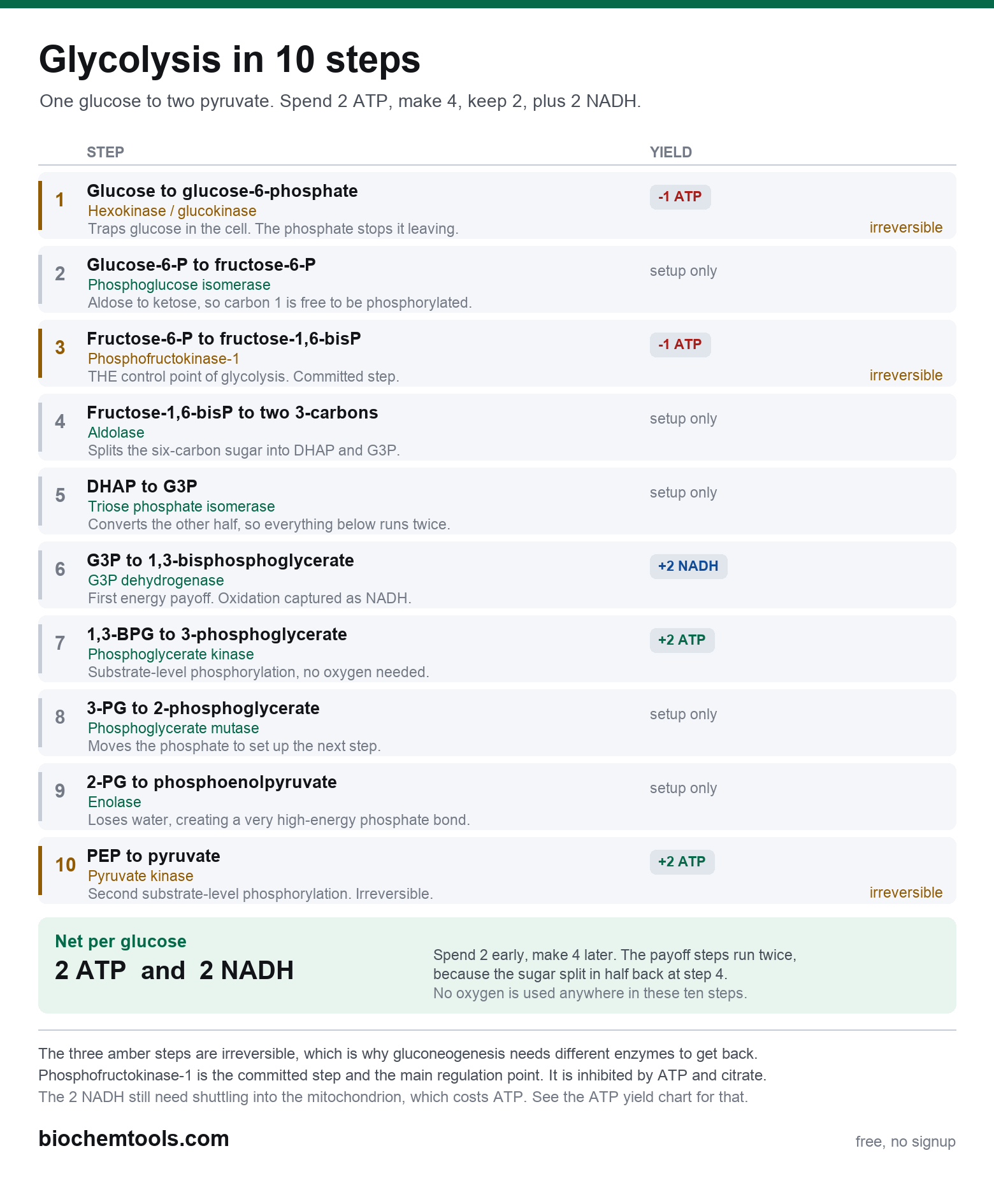
All ten steps on one page with the enzyme for each, where the ATP is spent and made, and which three steps are irreversible.
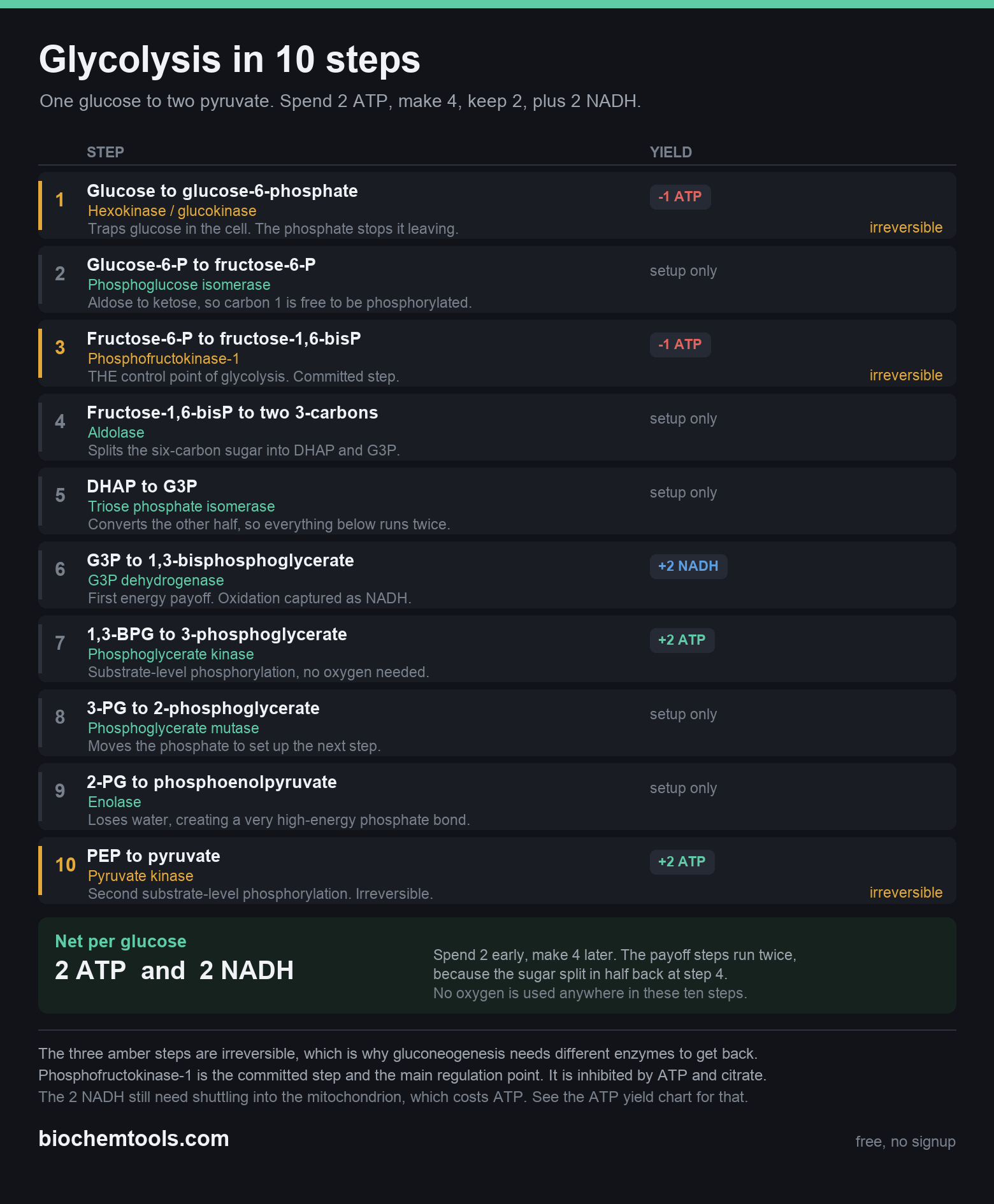
Download the chart, or the print-friendly white version. Free for a study guide or class handout, no attribution needed. See all the printable charts. The ATP accounting is summed from the step list itself and checked against the known net of 2 ATP and 2 NADH per glucose.
FAQ
What is the net ATP and NADH yield of glycolysis?
Per glucose: 2 ATP net (4 produced minus 2 invested), 2 NADH, and 2 pyruvate.
What are the three regulated steps?
Hexokinase (step 1), phosphofructokinase-1 (step 3, the committed step), and pyruvate kinase (step 10), all irreversible and regulated.
Why does the payoff phase run twice per glucose?
Aldolase splits the 6-carbon fructose-1,6-bisphosphate into two 3-carbon molecules (DHAP and GAP); triose phosphate isomerase converts DHAP into a second GAP. So every glucose yields two GAP molecules, and steps 6-10 happen once for each, doubling the ATP and NADH from that phase.
Why is PFK-1 called the committed step?
It's the first step that's both irreversible and unique to glycolysis, hexokinase's product can still be shunted into glycogen synthesis or the pentose phosphate pathway, but once PFK-1 acts, the molecule is committed to finishing glycolysis. That's why it's the pathway's main control point.
Does glycolysis need oxygen?
No, every step of glycolysis itself runs the same with or without O₂. What oxygen actually enables is what happens after glycolysis: reoxidizing the 2 NADH via the electron transport chain. Without O₂, cells regenerate NAD⁺ through fermentation instead (lactate or ethanol) so glycolysis can keep running, but the citric acid cycle and oxidative phosphorylation stay shut down, capping total yield at glycolysis's own 2 ATP per glucose.
Practice problems
1. If a cell processes 5 molecules of glucose through glycolysis, how much net ATP, NADH, and pyruvate result?
Show answer
2. Step 4 splits fructose-1,6-bisphosphate into DHAP and GAP, but only GAP continues directly into step 6. What happens to the DHAP, and why does this matter for the ATP/NADH count?
Show answer
3. A sprinting muscle cell runs out of oxygen faster than the electron transport chain can use it. Compare its total ATP yield per glucose to a resting cell with plenty of oxygen, and explain why fermentation itself doesn't close that gap.