How to classify one on sight
First ask direction: moving down a concentration gradient is always passive; moving against one always costs energy from somewhere. Then ask whether a protein is involved, no protein plus down-gradient is simple diffusion, a protein plus down-gradient is facilitated diffusion. For facilitated diffusion, a channel doesn't saturate (it's just a pore) while a carrier does (it cycles through a conformational change per molecule, exactly like an enzyme, which is why carrier kinetics look Michaelis-Menten-shaped). For against-gradient movement, direct ATP hydrolysis is primary active transport; spending another ion's gradient instead is secondary active transport, same direction is symport, opposite is antiport.
One precision point for charged solutes: an ion follows its electrochemical gradient, the combination of its concentration gradient and the membrane voltage, not concentration alone. An ion can even move against its concentration gradient if the electrical pull is strong enough, which is exactly why each ion has its own equilibrium potential (see the Nernst equation). For uncharged solutes like glucose, there's no electrical term, so "concentration gradient" is the whole story.
Related tools: Osmotic pressure & tonicity · Nernst equation calculator · Enzyme kinetics simulator · all biochem tools.
The Na⁺/K⁺-ATPase, in detail
The primary active transporter that sets up the ion gradients almost every secondary active transporter in the body spends. One cycle, one ATP:
Those gradients are what secondary active transporters like the Na⁺-glucose symporter (SGLT, intestine and kidney) and the Na⁺/Ca²⁺ exchanger (NCX, cardiac muscle) spend, no ATP touches them directly, but their energy traces back to this pump. And once you have the K⁺ gradient it maintains, you can plug it straight into the Nernst equation to find K⁺'s own equilibrium potential.
Printable transport chart
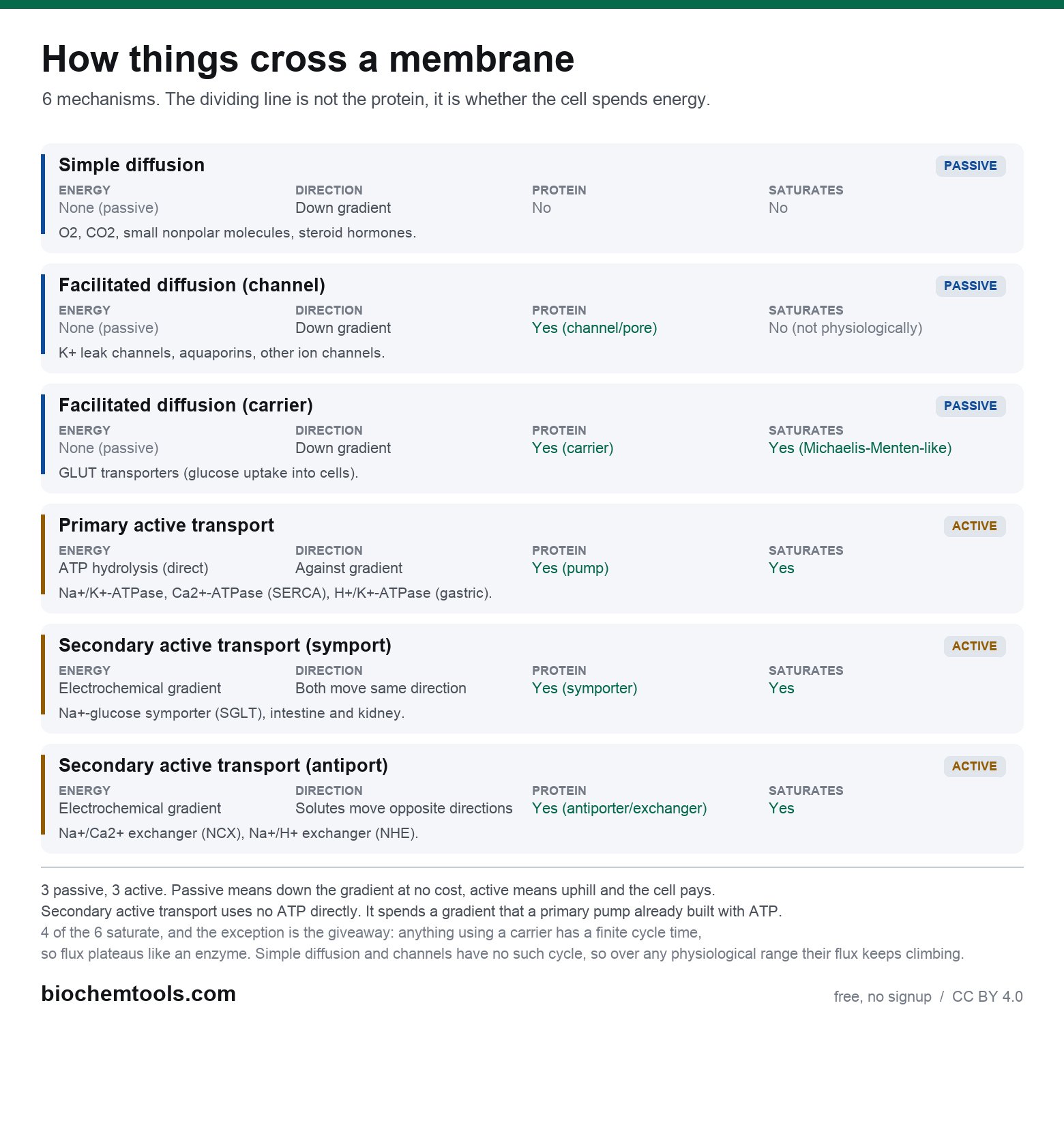
All six mechanisms side by side. The useful column is the last one: only carrier-mediated transport saturates, because a carrier has a cycle time and a channel does not.
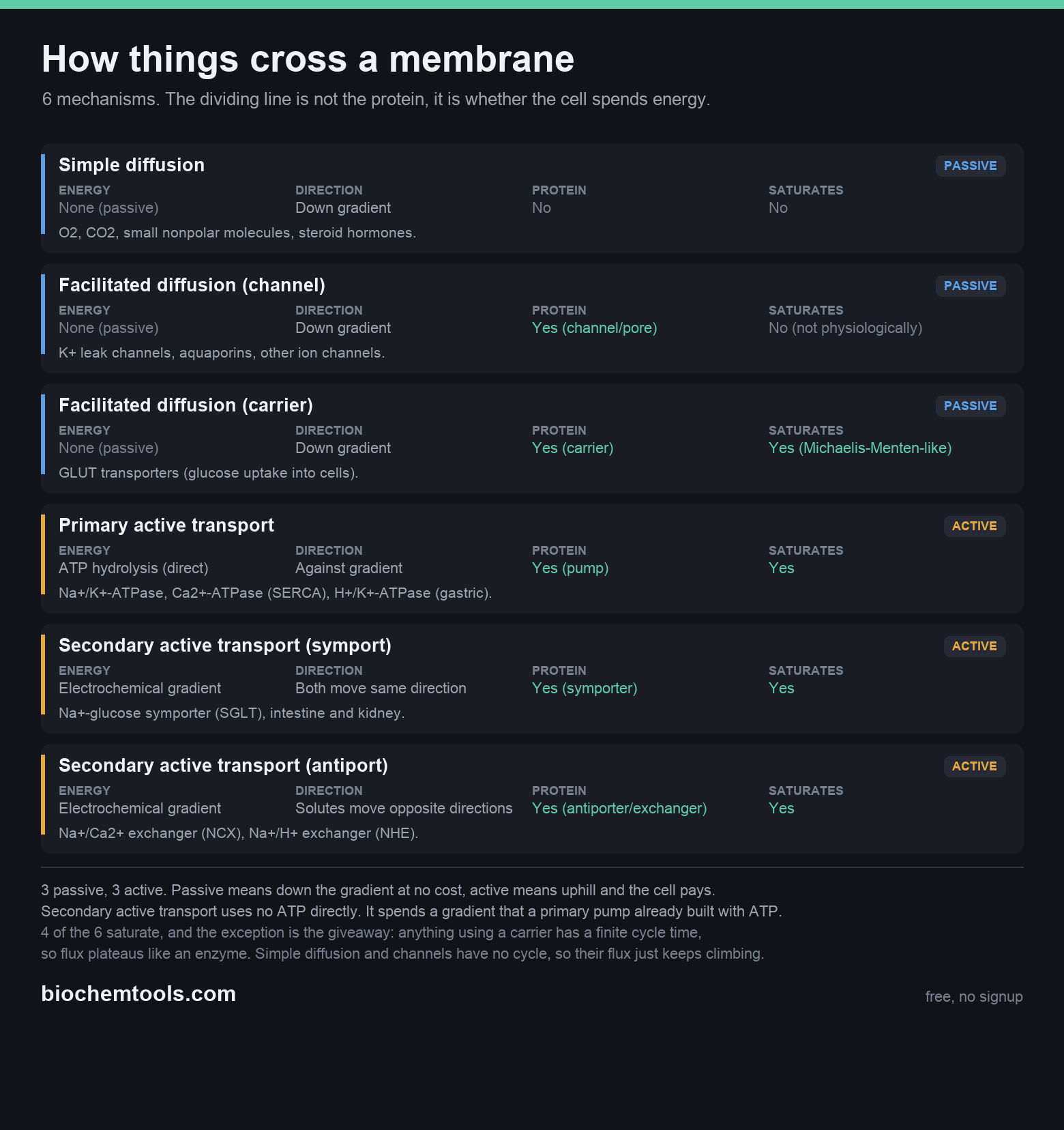
Download the chart, or the print-friendly white version. Free for a study guide or handout, no attribution needed. See all the printable charts.
FAQ
What's the actual difference between a channel and a carrier?
A channel is a pore, once open, solute flows through continuously with no per-molecule cycle, so flux keeps rising with concentration and doesn't really saturate. A carrier binds solute, changes shape to move it across, then resets. That cycle time creates a maximum rate, giving carriers Michaelis-Menten-shaped saturation kinetics.
Why is the Na⁺/K⁺-ATPase electrogenic?
3 Na+ out, 2 K+ in per cycle, a net +1 charge leaves the cell each time, directly contributing to the resting membrane potential.
If secondary active transport doesn't use ATP, where's the energy?
From the electrochemical gradient of the co-transported ion (usually Na+), which a primary pump already built using ATP. The energy is one step removed from ATP, not absent.
Why doesn't simple diffusion saturate?
No protein, no binding step to become rate-limiting, the solute just dissolves into and moves through the bilayer directly, so flux stays proportional to the gradient (Fick's law) with no plateau.
How does this connect to resting membrane potential?
The gradients active transport maintains are exactly what the Nernst equation uses to find each ion's equilibrium potential, and leak channels (facilitated diffusion) are what let the real membrane potential approach those values at rest.