How the classification actually works
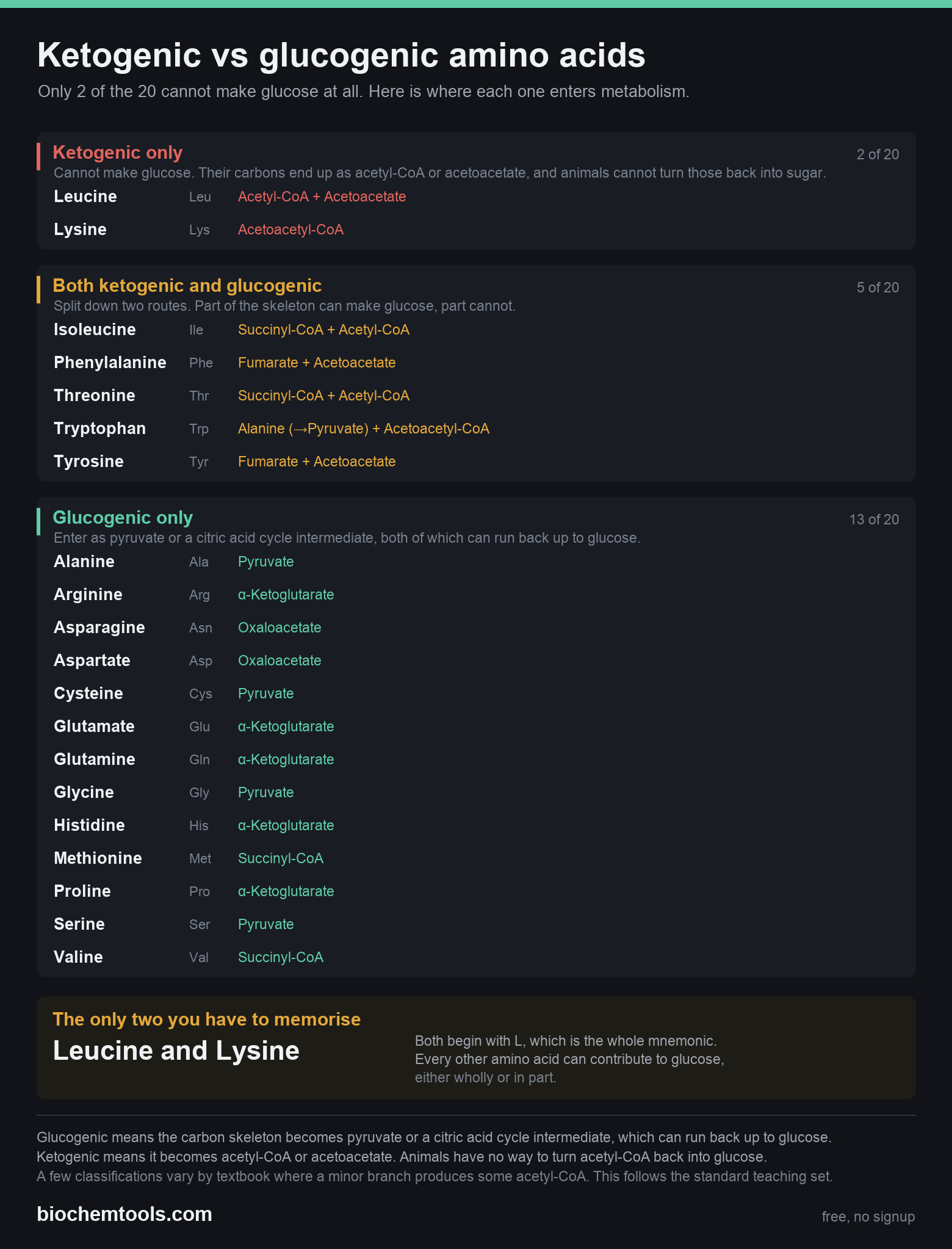
Every amino acid's alpha-amino group is removed first (transamination, usually onto α-ketoglutarate to form glutamate), leaving a carbon skeleton. That skeleton is broken down until it becomes one of five glucogenic entry points, pyruvate, α-ketoglutarate, succinyl-CoA, fumarate, or oxaloacetate, all of which can run through gluconeogenesis to make new glucose, or one of two ketogenic entry points, acetyl-CoA or acetoacetyl-CoA, which cannot, since pyruvate dehydrogenase only runs one direction in humans. A handful of amino acids split into two separate skeletons that land in both categories.
Related tools: Peptide charge & pI calculator · Citric acid cycle explorer · Amino acid chart (all 20) · all biochem tools.
The urea cycle: where the nitrogen goes
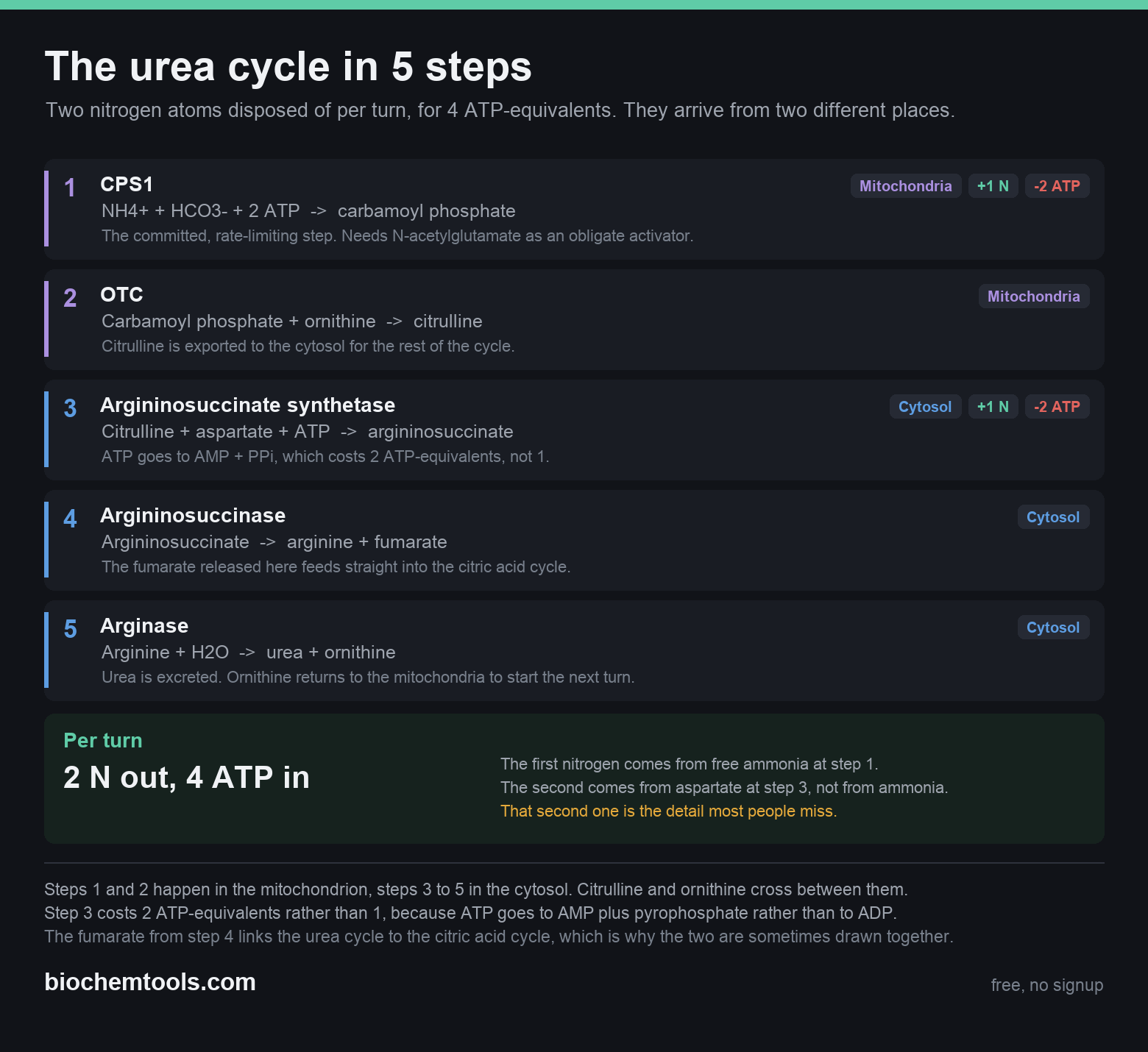
Free ammonia (as NH₃, largely protonated to ammonium NH₄⁺ at body pH) is toxic, so the body packages 2 nitrogen atoms per cycle into urea, a neutral, water-soluble molecule the kidneys excrete. The cycle starts in the mitochondrial matrix (steps 1–2), moves to the cytosol (steps 3–5), and ornithine shuttles back into the mitochondrion to begin the next turn.
NH₃ + HCO₃⁻ + 2 ATP → carbamoyl phosphate + 2 ADP + Pi
First nitrogen atom enters here, from free ammonia. Costs 2 ATP. This is the committed, rate-limiting step, and CPS1 requires N-acetylglutamate (NAG) as an obligate allosteric activator, no NAG, no urea cycle.
Carbamoyl phosphate + ornithine → citrulline + Pi
Citrulline is exported to the cytosol for the rest of the cycle.
Citrulline + aspartate + ATP → argininosuccinate + AMP + PPi
Second nitrogen atom enters here, from aspartate. ATP → AMP + PPi costs 2 ATP-equivalents (same accounting as fatty acid activation).
Argininosuccinate → arginine + fumarate
The released fumarate feeds directly into the citric acid cycle.
Arginine + H₂O → urea + ornithine
Urea is excreted; ornithine returns to the mitochondria to start the next turn.
Regulation: N-acetylglutamate (NAG) is made from glutamate + acetyl-CoA whenever amino acid breakdown is high, so the cycle automatically speeds up exactly when there's a lot of nitrogen to dispose of. This is why the cycle is regulated at CPS1: NAG is the sensor. (A genetic loss of the NAG-making enzyme, NAGS deficiency, causes hyperammonemia even though every urea-cycle enzyme itself is intact, a classic board-exam scenario.)
Full classification table (all 20)
| Amino acid | Class | Enters as |
|---|
Printable urea cycle chart
All five steps with the compartment each happens in, where the two nitrogen atoms come from, and the real ATP cost. The second nitrogen arrives from aspartate rather than ammonia, which is the part most people get wrong.
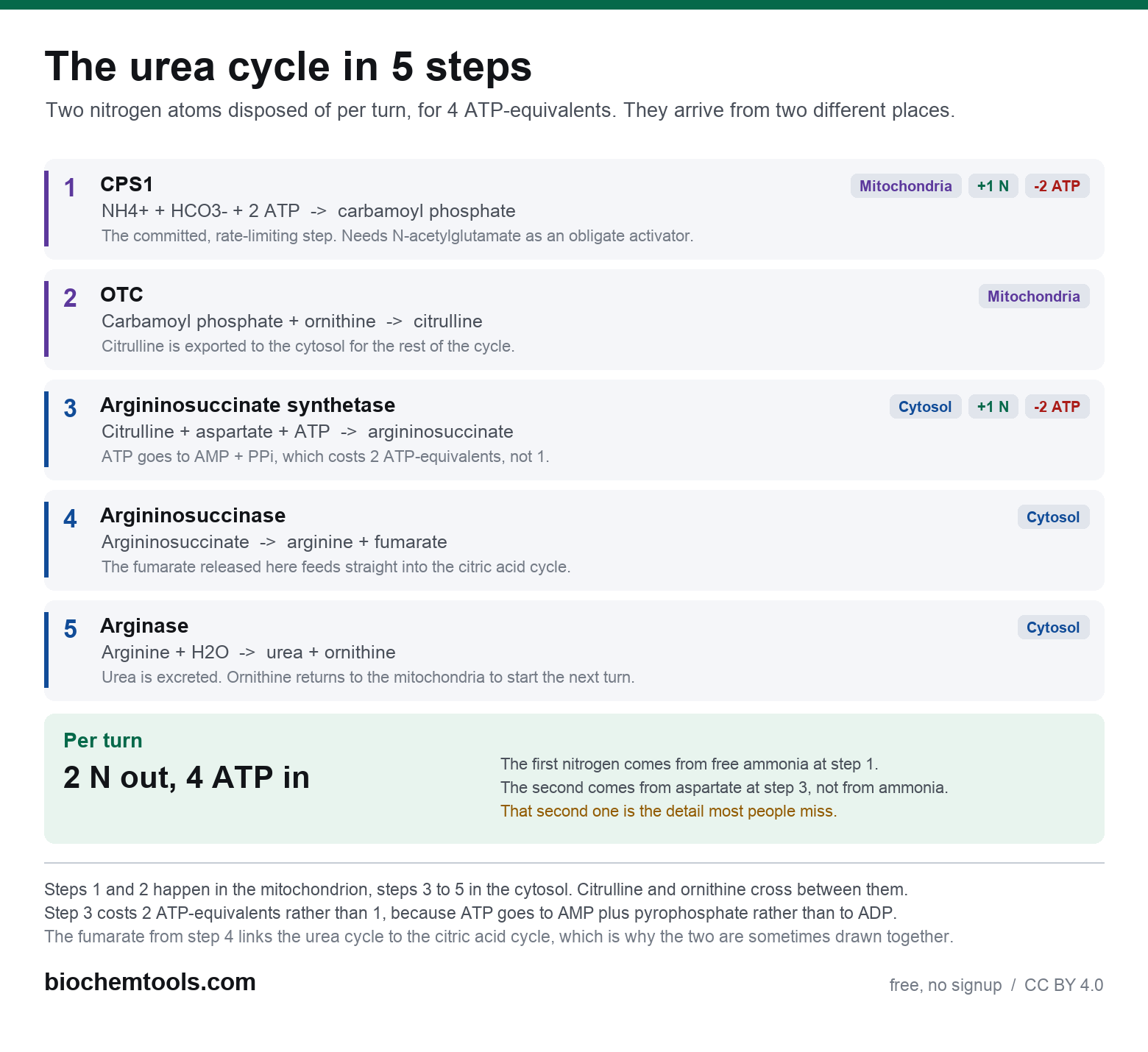
Download the chart, or the print-friendly white version. Free for a study guide or class handout, no attribution needed. See all the printable charts.
Printable catabolism chart
All 20 amino acids grouped by what their carbon skeleton can become, with the entry point for each. The useful fact is how lopsided it is: only two of the twenty cannot contribute to glucose at all.
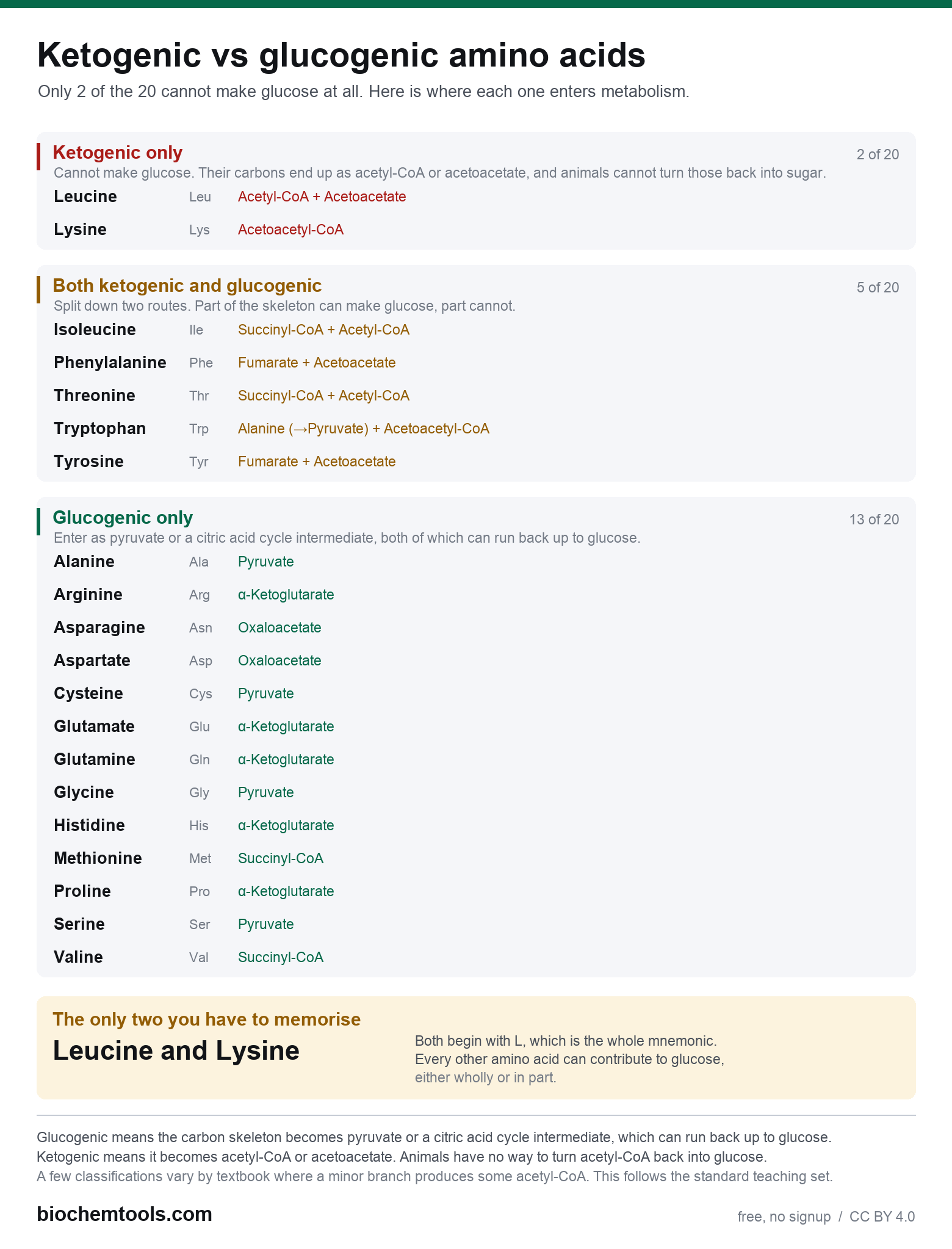
Download the chart, or the print-friendly white version. Free for a study guide or class handout, no attribution needed. See all the printable charts.
FAQ
Why can't acetyl-CoA be converted back to glucose?
Pyruvate dehydrogenase (pyruvate → acetyl-CoA) is irreversible in humans. Once a carbon skeleton becomes acetyl-CoA, it can be oxidized for energy or built into fat/ketone bodies, but it can never net contribute to new glucose. That irreversibility is the whole reason this classification exists.
Which amino acids are purely ketogenic?
Only leucine and lysine. Every other amino acid is purely glucogenic or both, one of the most commonly tested one-liners in amino acid metabolism.
Why does the urea cycle cost 4 ATP for only 2 nitrogen atoms?
Step 1 spends 2 ATP directly. Step 3 spends 1 ATP but converts it to AMP + PPi, counted as 2 ATP-equivalents since going to AMP removes two high-energy bonds instead of one. 2 + 2 = 4 ATP-equivalents per turn.
Where does the urea-cycle fumarate go?
It's released in the cytosol and can become malate then oxaloacetate, linking directly to the citric acid cycle, sometimes called the "Krebs bicycle." That oxaloacetate can transaminate back to aspartate, regenerating step 3's nitrogen donor.
Is threonine's classification settled?
Not entirely, most tables (including this one) list it as both, since a minor pathway makes some acetyl-CoA, but its dominant human pathway is glucogenic. Some textbooks simplify it to glucogenic-only; check your course's convention.