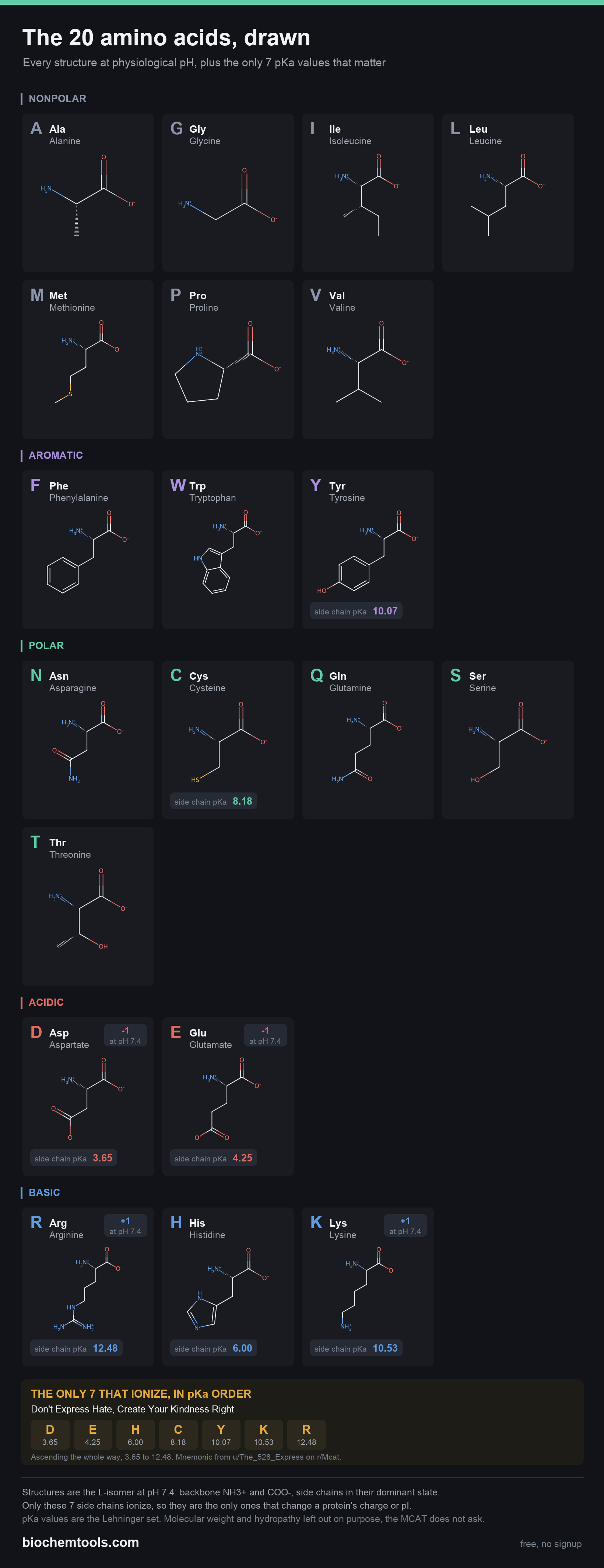
Eleven of them are just the first letter
Alanine, Cysteine, Glycine, Histidine, Isoleucine, Leucine, Methionine, Proline, Serine, Threonine, Valine. If the name starts with the letter, that is the code. Learn the other nine and you have all twenty.
The nine that do not match, and why
These are not arbitrary. In every case the obvious letter had already been claimed by another amino acid, so a nearby or phonetic letter was used instead.
| Amino acid | Code | Why |
|---|---|---|
| Arginine | R | A was taken by alanine. Think aRginine |
| Asparagine | N | A was taken by alanine. Think asparagiNe |
| Aspartate | D | A was taken by alanine. Think asparDic acid, or D for aciDic |
| Glutamate | E | G was taken by glycine. Think gluEtamic acid, and E follows D just as Glu is one carbon longer than Asp |
| Glutamine | Q | G was taken by glycine. Think Q-tamine |
| Lysine | K | L was taken by leucine. Think K sits next to L in the alphabet |
| Phenylalanine | F | P was taken by proline. Think Fenylalanine |
| Tryptophan | W | T was taken by threonine. Think tWyptophan, or the two rings of the indole drawn as a W |
| Tyrosine | Y | T was taken by threonine. Think tYrosine |
All twenty, for reference
| Name | 1-letter | 3-letter | Class |
|---|---|---|---|
| Alanine | A | Ala | Nonpolar |
| Arginine | R | Arg | Basic |
| Asparagine | N | Asn | Polar |
| Aspartate | D | Asp | Acidic |
| Cysteine | C | Cys | Polar |
| Glutamate | E | Glu | Acidic |
| Glutamine | Q | Gln | Polar |
| Glycine | G | Gly | Nonpolar |
| Histidine | H | His | Basic |
| Isoleucine | I | Ile | Nonpolar |
| Leucine | L | Leu | Nonpolar |
| Lysine | K | Lys | Basic |
| Methionine | M | Met | Nonpolar |
| Phenylalanine | F | Phe | Aromatic |
| Proline | P | Pro | Nonpolar |
| Serine | S | Ser | Polar |
| Threonine | T | Thr | Polar |
| Tryptophan | W | Trp | Aromatic |
| Tyrosine | Y | Tyr | Aromatic |
| Valine | V | Val | Nonpolar |
Where you actually meet these
One-letter codes are not a memory exercise for their own sake. They are how sequences get written down anywhere space matters.
FASTA files and sequence alignments use them exclusively, because a 300-residue protein written in three-letter codes is unreadable. A BLAST result is a wall of single letters.
Mutation notation uses them constantly. Sickle cell anaemia is written E6V: glutamate at position 6 replaced by valine. If you cannot read E and V on sight, the notation tells you nothing, and that is the form it appears in throughout the literature and on exams.
Restriction and cloning tools return translated sequences in one-letter code by default, including the DNA to protein translator here.
Other ways to drill these
The full amino acid quiz also tests three-letter codes and side-chain class. There is a sortable chart of all 20 with pKa values and molecular weights, and a printable structures chart if you prefer paper.