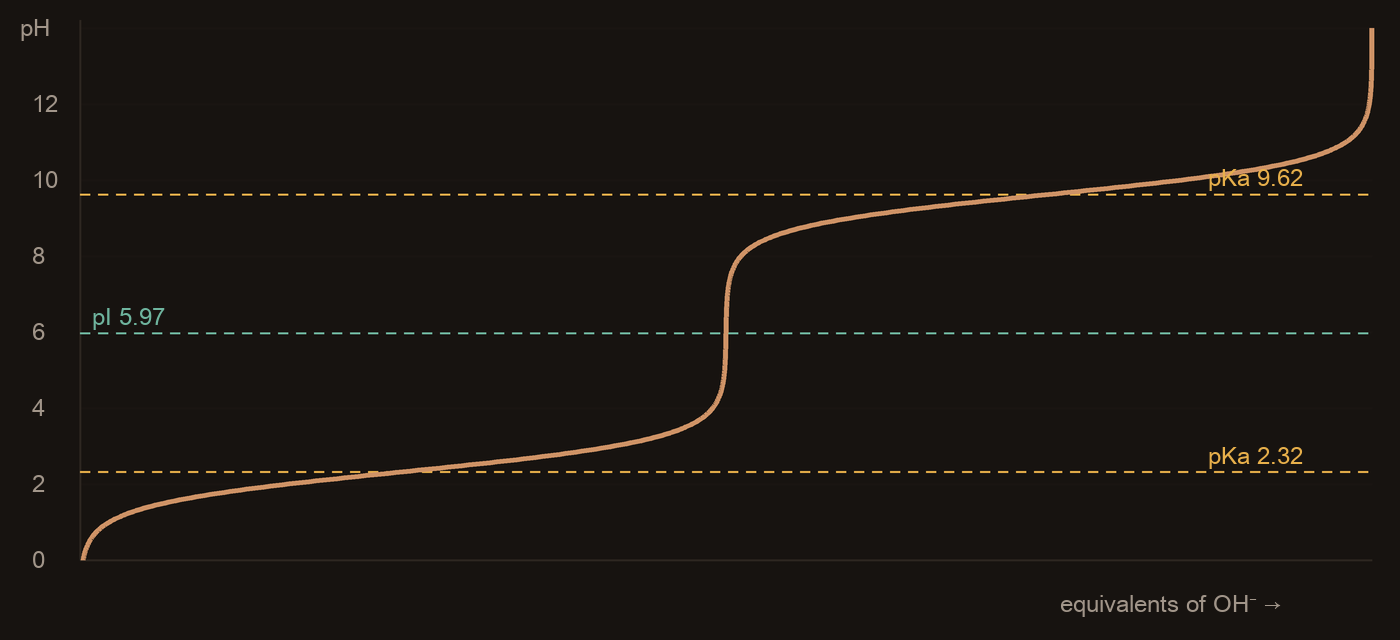
Valine has 2 ionizable groups, with pKa values of 2.32 and 9.62. Its isoelectric point is pI 5.97, and the curve has 1 equivalence point and 2 buffering plateaus.
The ionizable groups
| Group | pKa | Behaviour |
|---|---|---|
| alpha-carboxyl | 2.32 | loses H+ as pH rises |
| alpha-amino | 9.62 | keeps H+ until pH passes it |
Where it buffers
A weak acid buffers within about one pH unit either side of its pKa, which is the flat part of the curve. For valine that means:
| Buffering range | Centred on |
|---|---|
| pH 1.32 to 3.32 | pKa 2.32 |
| pH 8.62 to 10.62 | pKa 9.62 |
Equivalence points
Halfway between two pKa values the previous group is fully titrated and the next has not started. Those are the steep parts.
| Point | pH |
|---|---|
| Equivalence point 1 | pH 5.97 |
What charge it carries, and when
Reading the curve left to right, each pKa you pass strips off one proton and drops the net charge by one. Between two pKa values one species dominates:
| pH range | Net charge |
|---|---|
| below pH 2.32 | +1 |
| pH 2.32 to 9.62 | 0 |
| above pH 9.62 | -1 |
The charge is zero at the isoelectric point, which is why valine will not move in an electric field at pH 5.97. That is the basis of isoelectric focusing, and it is why the pI is the number worth remembering rather than the individual pKa values.
Net charge at physiological pH
At pH 7.4 no group is cleanly on or off. Each contributes a fraction, given by the Henderson-Hasselbalch relation, and the net charge is their sum:
- the acid group (pKa 2.32) contributes -1.00
- the base group (pKa 9.62) contributes +0.99
Net charge on valine at pH 7.4 = -0.01
This is the calculation behind every peptide charge question. Do it for each residue in a sequence and add the results, and you have the charge on the whole peptide.
Working out the pI
Valine has no ionizable side chain, so the neutral zwitterion sits between the two pKa values, and the isoelectric point is their average: (2.32 + 9.62) / 2 = 5.970, published as pI 5.97.
The other amino acids
Each of these has its own curve, its own buffering regions and a worked isoelectric point. The three-group side chains behave quite differently from the two-group ones, so it is worth looking at one of each.
Glycine · Alanine · Isoleucine · Methionine · Aspartic acid · Glutamic acid · Histidine · Lysine · Arginine · Cysteine · Tyrosine
You can also plot any amino acid's curve yourself, see all 20 with their pKa values, or run a whole sequence through the peptide charge and pI calculator.
Where the numbers come from
pKa values are the Lehninger set, the same ones used across this site. The curve is generated from those values with the Henderson-Hasselbalch relation for each group, and the pI is solved solved numerically as a check on the arithmetic above, which agrees to within 0.03 pH units.