Why the charge column. In ion exchange the buffer ion must not stick to the resin, or it gets stripped off and your pH drifts mid-run. Match the sign: a negative (cation exchange) resin wants an anionic buffer, a positive (anion exchange) resin wants a cationic one. Zwitterionic Good's buffers are usually safe with either. That is also why piperazine is worth knowing: it is one of only two cationic buffers covering pH 4.5 to 6.5, where nearly everything else is a carboxylate.
| Buffer | pKa (25°C) | Charge | pKa at your temp | Useful range | ΔpKa / °C |
|---|
How to pick a buffer
Match the pKa to your target pH, as closely as you can and within one unit at the outside. A buffer resists pH change only while both the acid and conjugate base forms are present in real amounts, and that is only true near the pKa. One full unit away, Henderson-Hasselbalch says the mix is already about 91% one form and 9% the other, so there is very little of the minority form left to absorb what you add. That is exactly where the accepted "pKa ± 1" window comes from, and why a buffer at the edge of its range fails much faster than one at its centre.
Then check the temperature column. Most tables quietly report pKa at 25°C, but you may be working in a cold room or at 37°C, and some buffers shift far more than others. Tris is the notorious one: adjust it to pH 8.00 on the bench and it is roughly pH 8.59 at 4°C and pH 7.66 at 37°C, nearly a full unit of swing. Phosphate and acetate barely move at all. Adjust the pH at the temperature you will actually use, or pick a buffer that does not care.
Related tools: Buffer calculator (exact amounts to mix) · Titration curve · pH calculator · Equation sheet · Antibody dilution calculator · all biochem tools. · the 3 MCAT buffer question types
Buffers to be careful with
| Buffer | Watch out for |
|---|---|
| Tris | Large temperature shift (−0.028/°C); also reacts with aldehydes and interferes with some protein assays |
| Phosphate | Precipitates with calcium and many divalent metals; inhibits several kinases and phosphatases; poor buffering pH 8.5–10 |
| Citrate | Strong metal chelator, so it strips required cofactors from many enzymes |
| Borate | Complexes with cis-diols, so it binds sugars, glycerol, and some nucleotides |
| Carbonate | Exchanges CO2 with the air, so the pH drifts in an open vessel |
| Glycine | An amino acid, so it can take part in reactions and interfere with amine assays |
Good's buffers (MES, PIPES, MOPS, HEPES, TES, TAPS, CHES, CAPS and relatives) were designed to avoid most of these problems: they are zwitterionic, water-soluble, barely bind metals, do not cross membranes easily, and are largely transparent in the visible and near-UV.
Printable buffer selection chart
Every buffer on this page drawn on a real pH axis. Each bar spans pKa plus or minus 1, the range where a buffer still has capacity, so you can see at a glance which ones cover your target pH.
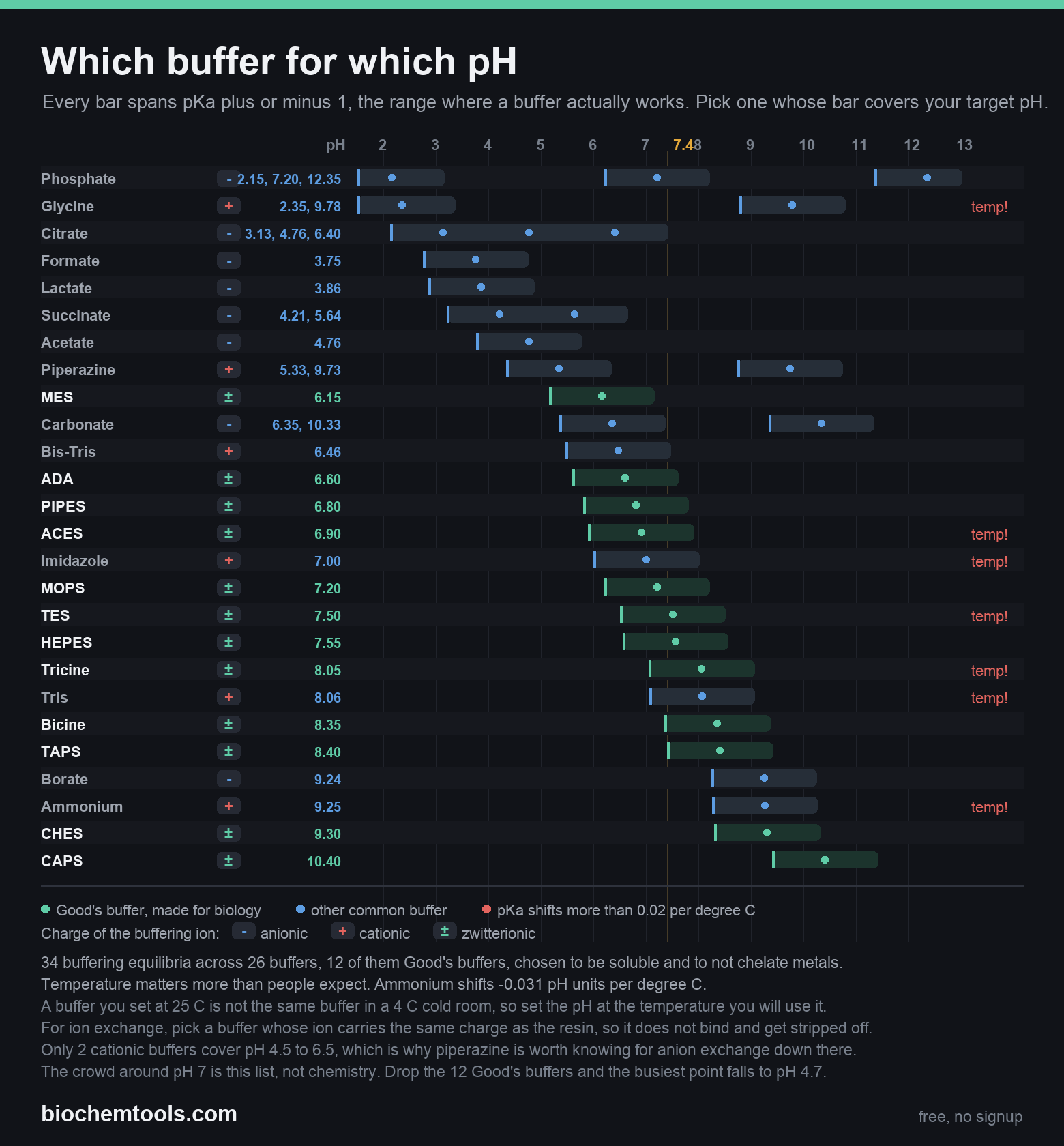
Download the chart, or the print-friendly white version that will not drain your ink. Free for a study guide or class handout, no attribution needed. See all the printable charts. Generated from the same buffer list this page uses, so the two cannot disagree.

FAQ
How do I choose a buffer?
Pick the pKa closest to your target pH, within ±1. For pH 7.4 that means TES, HEPES, or MOPS.
Why is the range pKa ± 1?
At one unit away the ratio is already 10:1, so ~91% sits in one form and only ~9% is left to neutralize what you add.
Why does Tris drift so much?
Its coefficient is about −0.028 per °C. pH 8.00 on the bench is ~8.59 at 4°C and ~7.66 at 37°C. Adjust at the working temperature.
What are Good's buffers?
Zwitterionic buffers picked for biology: physiological pKa range, soluble, minimal metal binding, membrane-impermeant, optically clear.
When should I skip phosphate?
With calcium or divalent metals, with kinases and phosphatases, when phosphate is a reactant, or between pH 8.5 and 10.
Sources and how to cite this page
The pKa values listed are the standard 25 °C values used throughout the buffer literature and in supplier reference tables. The zwitterionic buffers marked as Good's buffers (MES, PIPES, MOPS, HEPES, TES, TAPS, CHES, CAPS and relatives) come from the set developed in Good, N.E., Winget, G.D., Winter, W., Connolly, T.N., Izawa, S. & Singh, R.M.M., “Hydrogen ion buffers for biological research,” Biochemistry 5(2):467–477, 1966.
About the temperature correction. The d(pKa)/dT figures are the accepted per-degree coefficients for each buffer, and the calculator applies them linearly. That is accurate over the range you would normally work in, roughly 4 to 37 °C, but it is a first-order approximation, not an exact model. Tris is the one to watch: at about −0.028 pH units per degree it moves nearly a full pH unit between a cold room and 37 °C, so pH it at the temperature you will actually use it.
Why so many buffers cluster around pH 7. That crowding is a property of this list, not of chemistry. Twelve of the 32 buffers here are Good's buffers, which were deliberately selected to span the physiological range. Take those twelve out and the busiest point on the axis drops from pH 7.1 to pH 3.8. So read the dense band as "this is where people have done the most work," not as "buffering is easier here." Raised by a reader on r/Biochemistry, and a fair hit.
A little history. Norman Good spent his career as a photosynthesis researcher at Michigan State from the 1950s through the 1990s. A reader whose PhD committee member inherited Good's lab space describes the original handwritten protocol notebooks for synthesizing the buffers still being there, and rotating graduate students being asked to make their own batch as a kind of entrance test. Good never patented any of the formulations. Every buffer on this chart traces back to work that was given away for free, which is a fair reason to keep this page that way too.
Why published pKa values differ slightly. pKa is measured, not derived, so a tabulated value depends on temperature and ionic strength. Values here are for dilute aqueous solution near 25 °C. Differences of roughly 0.1 to 0.3 pKa units between references are normal and do not mean one is wrong. If you are citing a number for coursework, cite the source you were taught from and stay consistent with it.